
Quick Answer: A 2026 MVP can cost roughly $10,000–$30,000 for a narrow product, $30,000–$100,000 for a multi-workflow application, and more than $100,000 for regulated or technically complex software. These are USD planning ranges for outsourced custom software delivery, not market guarantees. Budget depends on validation scope, architecture, integrations, security, compliance, delivery model, and post-launch operating costs.
- How much does MVP development cost in 2026?
- Which factors drive MVP cost the most?
- Which MVP delivery model fits your stage?
- Where do MVP budgets get wasted?
- How can an AI-assisted SDLC reduce cost without hiding risk?
- What should an MVP estimate include?
- How should founders compare MVP ROI and TCO?
- Is a production MVP the right next step?
- What is the practical budgeting decision?
How much does MVP development cost in 2026?
The practical answer is a range tied to the evidence the MVP must produce. A prototype that tests desirability is not equivalent to a production MVP that stores personal data, takes payments, and must pass a customer security review.
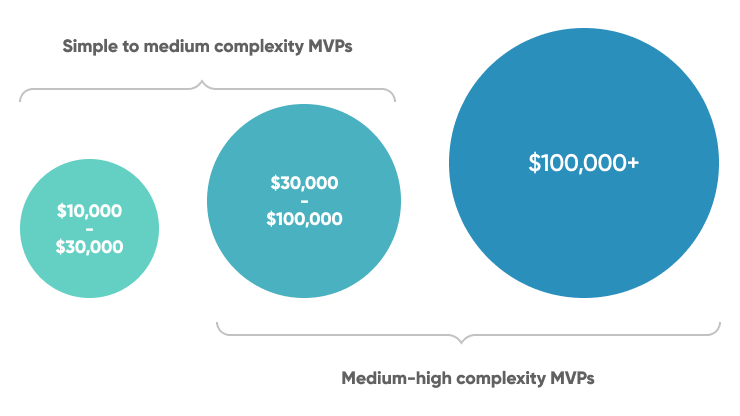
- Narrow MVP: $10,000–$30,000. One primary workflow, a web interface, managed authentication, basic analytics, and few integrations. This range usually assumes limited custom design and no demanding regulatory requirements.
- Multi-workflow MVP: $30,000–$100,000. Several user roles, an admin interface, payments or CRM connections, background processing, richer UX, and production deployment.
- Complex or regulated MVP: $100,000+. Advanced authorization, audit trails, high-volume data processing, real-time behavior, extensive integrations, bespoke AI development, or formal compliance controls can move the budget above $100,000.
These figures are editorial planning ranges, not independently validated market averages. Delivery location, seniority mix, commercial model, and the period of post-launch support can materially change the price. Compare vendor proposals against the same acceptance criteria, non-functional requirements, staffing assumptions, and support period.
What could a B2B MVP budget look like?
An illustrative 12-week B2B workflow MVP with a web app, managed authentication, two user roles, an admin interface, one CRM integration, analytics, and QA could have a $65,000–$85,000 build budget plus $1,500–$4,000 per month for cloud, monitoring, support tooling, and routine maintenance. A reasonable success threshold could be that 30% of invited users complete the core workflow twice within 14 days.
This is a planning scenario, not a SoftKraft case-study result. The scope is comparable to SoftKraft’s Workforce Training SaaS Platform MVP Development case study, which describes architecture, React Native apps, a Python backend, testing, and QA, but does not publish a project budget or outcome metrics.
Which factors drive MVP cost the most?
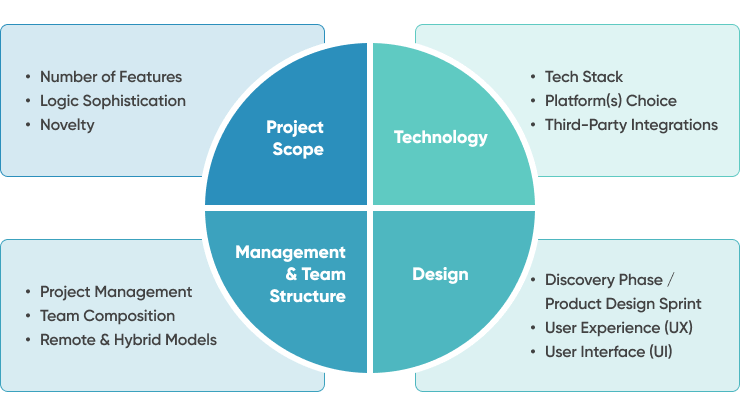
Scope, integration risk, non-functional requirements, and delivery uncertainty usually affect cost more than the programming language alone.
What scope should the first release include?
Fund the smallest release that can test a defined business hypothesis. Every feature should map to a measurable outcome such as activation, paid conversion, task completion, retention, or reduced processing time. A feature without a target metric belongs in the backlog until evidence justifies it.
Novel algorithms, real-time collaboration, migration of legacy data, and unclear third-party APIs require discovery or technical spikes. Make those uncertainties visible in the estimate instead of hiding them inside a fixed feature list.
How does architecture change the budget?
For many B2B MVPs, a Python/FastAPI modular monolith with PostgreSQL is cheaper to build and operate than premature microservices. It keeps deployment and transaction management simple while preserving module boundaries for later extraction.
Use a queue and background workers for email, report generation, webhook retries, file processing, and other tasks that should not block an API request. On AWS, an initial design might use ECS or Lambda, RDS for PostgreSQL, S3 for object storage, and SQS for queued jobs. The exact services should follow workload, data residency, and team capability—not a default cloud diagram.
Record portability decisions. Standard containers, PostgreSQL, infrastructure as code, and a documented export path can reduce vendor lock-in. Managed proprietary services may still be justified when lower operating effort outweighs migration risk.
Which security and compliance controls belong in an MVP?
Security scope should follow data sensitivity and buyer requirements. A production MVP commonly needs least-privilege IAM (cloud permissions limited to what a service needs), application-level RBAC (access rules by user role), encryption in transit and at rest, secrets management, dependency scanning, backups, and tested restore procedures.
Regulated or enterprise sales may also require audit logs, data retention rules, regional hosting, subprocessors, incident procedures, and evidence that controls operate. Data residency is an architectural constraint: identify where primary data, backups, logs, and vendor-processed data are stored before selecting AWS regions and external services. Do not claim GDPR, SOC 2, HIPAA, or ISO compliance solely because a cloud service supports relevant controls.
Which MVP delivery model fits your stage?
Choose the model based on coordination cost, product uncertainty, and the capability needed after launch.
- Freelancers: Suitable for bounded tasks when a technical owner can define architecture, review code, and coordinate delivery. Lower rates can be offset by management and continuity risk.
- Low-code or AI coding platforms: Useful for prototypes and simple internal workflows. Before committing, test data export, access control, integration limits, pricing at expected usage, and the cost of migrating custom logic.
- Product development partner: Useful when discovery, UX, architecture, engineering, QA, and cloud delivery must operate as one team. Compare evidence of shipped outcomes, team seniority, source-code ownership, and handover terms.
- In-house team: Provides direct control and retained knowledge but adds recruitment lead time, salaries, management, and tooling. It often becomes more economical when validated demand supports a durable product team.
Ask each candidate MVP development team to estimate the same scope and disclose assumptions, exclusions, team allocation, dependencies, warranty, and support.
Where do MVP budgets get wasted?
Most avoidable spend comes from building before deciding what must be learned, or from omitting production requirements until late delivery.
Should standard capabilities be built from scratch?
Usually not. Managed or reusable components can cover authentication, billing, email, file storage, audit logging, and deployment foundations. The decision still requires due diligence on licensing, source ownership, security updates, portability, and fit with the product's authorization model.

Custom development is justified when a capability differentiates the product, creates a regulatory advantage, or cannot meet requirements through a maintained component. Otherwise, spend engineering time on the workflow customers will evaluate.
How does over-scoping increase validation cost?
Over-scoping raises the amount at risk before the core hypothesis has evidence. Define the target segment, problem, behavior change, and decision threshold before development.

For example: “At least 30% of invited operations users complete the primary workflow twice within 14 days.” The threshold is not universal; it should reflect the business model and baseline. Instrument the funnel before launch so the team can distinguish acquisition failure, onboarding friction, and weak product value.
Which shortcuts create expensive technical debt?
Skipping automated tests, database migration discipline, authorization boundaries, deployment automation, or telemetry can reduce the first invoice while increasing release risk and support cost.

A proportionate baseline includes code review, test coverage for critical paths, repeatable CI/CD (automated build, test, and release steps), separate environments, rollback procedures, and architecture decision records. Avoid designing for hypothetical global scale, but document the triggers—such as queue depth, API latency, database load, and tenant count—that would justify scaling work.
Why do feedback loops need explicit metrics?
Unstructured feedback encourages stakeholders to prioritize anecdotes. Pair interviews with product analytics and operational measures.

Track a small set of metrics: activation rate, time to first value, completion of the core workflow, cohort retention, paid conversion where relevant, and support requests per active account. For delivery health, track lead time, deployment frequency, escaped defects, change failure rate, and mean time to restore. Use observability—logs, metrics, traces, and error tracking—to collect the operational data needed for those decisions. Decide before launch which results trigger iteration, a pivot, or stopping investment.
How can an AI-assisted SDLC reduce cost without hiding risk?
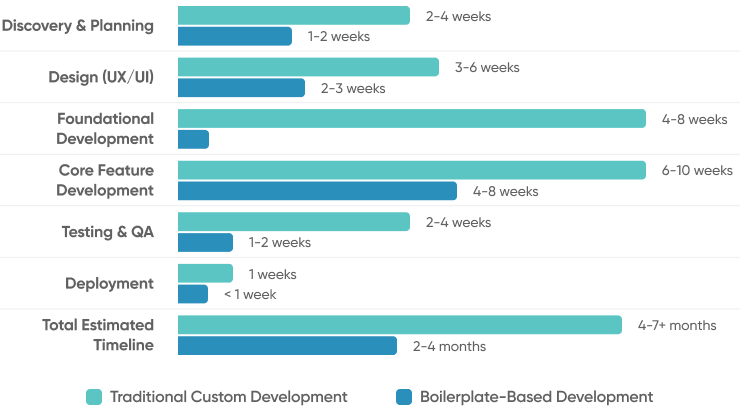
AI-assisted delivery can reduce time spent on planning artifacts, boilerplate, tests, and routine refactoring. Savings are not automatic: generated code still needs human review, automated verification, security controls, and clear accountability.
At SoftKraft, the delivery approach combines a reusable Python Blueprint, Claude Code, and the BMAD Method, an AI-assisted planning workflow. These components reduce repeat work only when discovery, test strategy, and acceptance criteria are defined.
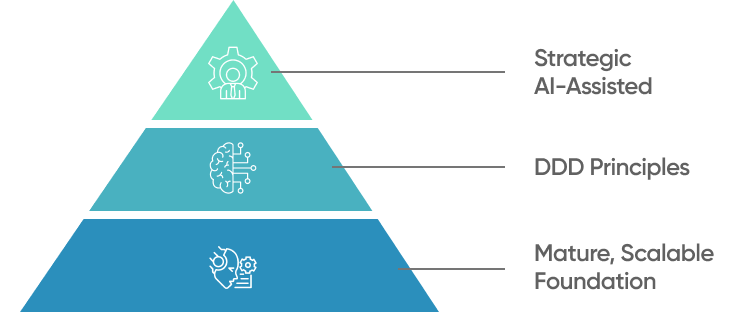
- Python Blueprint: Reusable FastAPI, PostgreSQL, authentication/RBAC, background-job, CI/CD, and observability foundations; each project still requires fit and security review.
- Domain modeling: Separates product rules from infrastructure so workflow changes do not spread across controllers, jobs, and integrations.
- Claude Code and BMAD Method: Support implementation, verification, scope decomposition, and estimation. Pull-request review, testing, scanning, runtime monitoring, discovery depth, and explicit assumptions remain necessary.
What do SoftKraft's internal delivery benchmarks show?
SoftKraft's internal project records report 4–10x velocity gains on selected AI-native work. A Mindlex case metric records 70% of the project delivered in 2.5 weeks, approximately 100% AI-generated code, and 37 features shipped in 54 hours.
These are internal case metrics, not universal market evidence. Without consistent definitions for “feature,” “delivered,” and “AI-generated,” plus a documented comparison baseline, the figures cannot predict another project's outcome. Prospective buyers should evaluate comparable lead time, defect, rework, and acceptance data rather than extrapolate one project.
SoftKraft's internal effort model estimates the following reusable foundation work:
- Authentication, MFA readiness, and RBAC: 80–120 hours
- User profiles: 20–30 hours
- Basic administration: 60–100 hours
- Subscription and payment integration: 50–80 hours
- API and security foundations: 40–60 hours
- Deployment and CI/CD: 30–50 hours
- Logging, error tracking, and health checks: 20–40 hours
The listed ranges total 300–480 hours. At an illustrative $50 blended hourly rate, the arithmetic equals $15,000–$24,000, before project-specific adaptation. Both hours and rate are SoftKraft planning assumptions and should not be presented as an industry benchmark.
What should an MVP estimate include?
A decision-grade estimate separates build cost, uncertainty, and operating cost. Request:
- Scope and acceptance criteria: User roles, workflows, integrations, migration, and explicit exclusions.
- Architecture: Runtime, PostgreSQL design, background jobs, cloud services, environments, and expected scale.
- Security: IAM, RBAC, encryption, secrets, backups, audit requirements, and vulnerability management.
- Delivery controls: CI/CD, testing strategy, code review, infrastructure as code, release and rollback.
- Observability: Structured logs, metrics, traces where useful, error tracking, alert ownership, and retention.
- Compliance evidence: Policies, logs, change records, access reviews, data flows, data residency, and vendor responsibilities.
- Commercial terms: Fixed-price or time-and-materials assumptions, change control, IP ownership, warranty, support, and handover.
A fixed price transfers only risks covered by the agreed assumptions. Unresolved integrations, research work, or changing compliance requirements need contingency, staged discovery, or time-and-materials treatment.
How should founders compare MVP ROI and TCO?
Compare options over a defined horizon—often 12 to 24 months—rather than selecting the lowest build quote.
TCO = discovery + design + development + cloud and vendor fees + security/compliance work + support + maintenance + expected rework or migration.
Include AWS usage, observability platforms, email and payment services, AI API consumption, backups, environments, and on-call ownership. Model a base case and a higher-usage case because per-request services can change unit economics as adoption grows.
Expected ROI = (risk-adjusted value created − TCO) / TCO.
For an MVP, value is often evidence rather than profit: validated demand, shorter sales cycles, lower manual processing cost, or a justified decision not to fund a larger build. Assign a time window and decision threshold to each outcome. If the MVP cannot change a funding, product, or operating decision, reduce its scope or reconsider whether software is the right experiment.
Is a production MVP the right next step?
Build a production MVP when the problem and target user are sufficiently defined, the core workflow needs real-world validation, and the organization can support users after launch.

Start with a prototype, software proof of concept, or discovery sprint when technical feasibility, desirability, or scope remains unclear. A landing page may be enough to test acquisition messaging. Deep-tech products may need an R&D milestone before application development.
For a production build, confirm:
- One primary hypothesis and measurable success criteria
- A named owner for product decisions
- Access to representative users
- A budget for launch, measurement, and at least one iteration
- Data, security, and compliance requirements
- A post-launch operating and ownership model
The guide to building an MVP explains the broader product process; this cost framework helps compare the financial and architectural implications.
What is the practical budgeting decision?
Set the budget from the evidence required, then price the architecture and controls needed to collect that evidence safely. A narrow scope with explicit acceptance criteria, measurable validation thresholds, and a proportionate production baseline gives vendors a comparable target.
Review reusable components, AI-assisted delivery claims, and fixed-price offers against source ownership, test evidence, security controls, portability, and post-launch TCO. To discuss a scoped estimate, contact SoftKraft's MVP development team.