

Software Development for Finance: 7 Key Trends in 2026
Quick Answer: Financial software priorities in 2026 are agentic AI with deterministic payment controls, DORA-aligned operational resilience, open-finance APIs, instant-payment workflows, real-time fraud prevention, intelligent document processing, and governed predictive analytics. CTOs should treat each as an architecture and operating-model decision: define data boundaries, identity, audit evidence, failure handling, and measurable business outcomes before expanding a pilot.
Financial services teams are connecting core banking platforms, payment rails, KYC providers, cloud data platforms, AI services, and regulatory controls into one accountable operating model. The strongest technology investment reduces a specific queue, loss rate, onboarding delay, or cost per transaction while preserving security and auditability.
What does financial software development require in 2026?
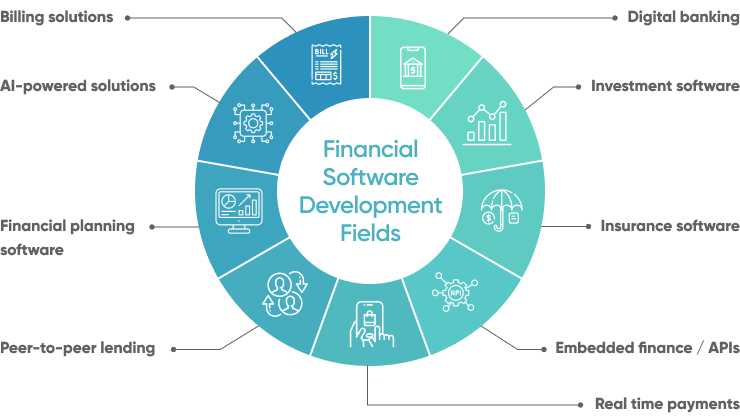
Financial software supports regulated customer journeys such as onboarding, account aggregation, payments, lending, insurance, trading, reconciliation, and regulatory reporting. Each journey combines sensitive data, third-party dependencies, and irreversible state changes. The architecture therefore needs explicit controls for identity, consent, authorization, ledger integrity, observability, and incident response.
For EU-regulated organizations, the baseline includes the Digital Operational Resilience Act (DORA), applicable since 17 January 2025. DORA covers ICT risk management, incident reporting, resilience testing, and third-party ICT risk. It does not replace legal advice, but it means a delivery team should make cloud-provider dependencies, recovery objectives, security testing, and evidence retention visible from discovery onward.
Which constraints should a CTO validate before selecting technology?
- Regulatory perimeter: Identify the countries, licenses, payment services, credit decisions, privacy rules, and outsourcing obligations affected by the product.
- Data and identity: Classify personally identifiable information (PII), transaction data, know-your-customer (KYC) evidence, and model inputs; define encryption, retention, residency, consent lifecycle, and least-privilege access.
- Transaction integrity: Use idempotency keys, auditable ledger logic, signed webhooks, reconciliation jobs, and clear states for submitted, authorized, settled, failed, and reversed transactions.
- Operational resilience: Define service-level objectives (SLOs), recovery time and recovery point objectives, alert ownership, and manual fallbacks for payment, onboarding, and fraud-review paths.
- Economic value: Establish a baseline for straight-through-processing rate, false-positive fraud rate, manual-review time, conversion, cloud cost per transaction, or time to regulatory report before funding a build.
What should a financial software roadmap include next?
Prioritize one workflow where the business outcome and control requirements are both measurable. Map the customer journey, source systems, data classification, regulatory owners, third parties, failure modes, and baseline KPI. Then deliver a thin but production-minded slice: secure access, audit trail, observability, reconciliation, and manual fallback before broad automation.
For CTOs and founders, the 2026 question is not which trend sounds most innovative. It is which architecture can safely improve a financial workflow and remain operable when an API, model, payment rail, or vendor fails. A specialist financial software development team can help define that boundary, validate the integration and compliance scope, and build a delivery roadmap around measurable operational and commercial outcomes.