
According to recent studies, nearly 90% of startups fail within the first five years, often due to poor strategic planning and technical execution. One of the most fundamental pieces of startup strategy is selecting the right technology stack. This decision can significantly influence a startup’s success.
With 12+ years as a Python Tech Lead at SoftKraft, I’ve helped dozens of founders pick their tech stack. Django comes up more often than not, and this guide gives you the unfiltered view from someone who’s helped startups and scale-ups choose (and sometimes pivot from) it.
Basics of the Django web development framework
First let’s start by going over some of the basics of this framework. Django is a high-level, open-source Python web framework that enables rapid development and clean, pragmatic design. Django functions with a robust architecture that follows the Model-View-Template (MVT) pattern, as illustrated in the graphic:
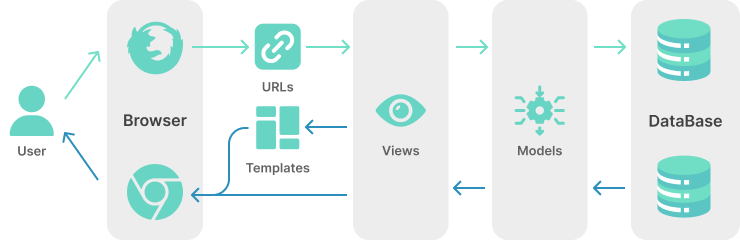
Here’s a brief explanation of the key components:
- Browser: The user interacts with the application via a web browser, making requests and receiving responses.
- URLs: Django uses a flexible URL routing system to map these requests to the appropriate views.
- Views: Views process the requests, handle business logic, and interact with the models if needed. They then pass the necessary data to templates.
- Models (ORM): Django’s Object-Relational Mapping (ORM) allows you to define your data models in Python and seamlessly interact with the database.
- Templates: Templates are responsible for rendering the HTML that is sent back to the user’s browser. They receive data from views and generate the final HTML output.
- Database: The database stores the application's data, which can be managed and queried using Django's ORM.
This clear separation of concerns not only makes development more manageable but also ensures that each component can be independently modified and scaled as needed. It aims to make it easier to build web applications with less code and a strong emphasis on reusability and "pluggability" of components.
6 pros of Django for startups
Django offers numerous advantages for startups, making it a popular web framework for building web applications. Its robust feature set, focus on rapid development, and strong community support help startups bring their products to market quickly and efficiently. Below, we explore the key benefits that make Django a valuable tool for startups.

Rapid development
For startups, time is often the most critical resource. Django's framework is specifically designed to support rapid development, allowing startups to get their products to market more quickly. This is achieved primarily through Django’s "batteries included" philosophy, meaning it comes with a multitude of built-in features and tools, such as:
- ORM for database Interactions: Django's Object-Relational Mapping (ORM) allows developers to interact with databases using Python code instead of SQL, simplifying database queries and ensuring database-agnostic applications.
- Authentication system: Django includes a robust authentication system out of the box, providing secure user authentication and authorization mechanisms, password hashing, and user session management.
- Admin interface: The built-in admin interface is a powerful tool for managing application data. It auto-generates admin panels for models, enabling quick content management without additional coding.
- Form handling: Django's form library simplifies the creation, validation, and processing of HTML forms, reducing boilerplate code and improving the handling of user input.
These out-of-the-box functionalities reduce the need for third-party integrations and custom implementations, saving valuable development time and allowing teams to focus on building core features. Additionally, Django adheres to the "Don't Repeat Yourself" (DRY) principle, which emphasizes reducing the repetition of source code patterns. By reusing common patterns and components, developers can write less code and achieve more in less time.
When a startup walks into our office at SoftKraft, the first thing we evaluate is how fast they can validate their idea with real users. Django consistently wins here because it ships a functional MVP with authentication, admin, forms, and database handling already solved.
Cost-effective development
Rapid development and cost savings go hand in hand. The faster the development, the lower your development costs, assuming the quality remains consistent. Django stands out as a cost-effective option due to its extensive range of built-in features, which minimize the need for purchasing and integrating third-party tools, significantly lowering initial development expenses. This is especially valuable for startups who are building a proof of concept or MVP, where the focus is on quickly building something with a few core features rather than a more complex product with many features.
In the long term, Django's scalability ensures that as your startup grows, the framework can handle increased demands without requiring a complete overhaul. This scalability means that initial investments in Django development continue to pay off as your business expands. By avoiding the need for significant additional expenditure down the line, Django provides a sustainable solution that supports your startup’s growth efficiently and cost-effectively. The ability to scale seamlessly ensures that your development efforts remain aligned with your business needs, delivering ongoing value as your startup evolves.
PRO TIP: Leverage Django's built-in features and reusable components to prototype quickly and iterate often. By doing so, you can validate your startup's ideas with minimal investment, allowing you to allocate more resources towards refining and scaling successful features. This approach not only conserves budget but also accelerates your path to market.
Read More: [Product Validation: 12 Ways to Test Your Product [with Examples]](/product-validation/)
Vibrant community and support
The Django framework boasts one of the most active and engaged developer communities in the web development ecosystem:
This community-driven environment offers startup founders and CTOs a plethora of resources and support, crucial for overcoming the inevitable challenges of building and scaling new web applications.
The collaborative nature of the Django community means that developers can easily find solutions, share knowledge, and stay updated with best practices, significantly enhancing productivity and reducing development time. You can expect the following as you engage with the Django developer community:
- Detailed documentation: Django offers step-by-step instructions for installing and configuring the framework, enabling teams to quickly get up and running. These guides not only cover the basics but also include advanced configuration tips to tailor the setup to the specific needs of your own app.
- Comprehensive tutorials: From beginner to advanced topics, Django’s extensive tutorials ensure all team members can find relevant learning materials. These tutorials often include real-world examples, code snippets, and projects, allowing developers to apply what they've learned directly to their work writing code.
- API references: The API documentation provides clear, detailed explanations of all Django functions and classes. This helps developers understand the full capabilities of Django and implement specific features effectively.
- Best practices: Following these best practices not only improves code quality but also makes it easier for new team members to onboard and understand the codebase, particularly in complex areas like the user model.
- Troubleshooting tips: The community and official documentation highlight common issues and their solutions, enabling developers to quickly resolve problems and minimize downtime. This is especially helpful when encountering challenges unique to your own app.
- Performance optimization: Django provides tips and techniques for optimizing applications, ensuring they run efficiently and can handle increased load as the startup scales. This includes guidance on caching, query optimization, and putting business logic in the appropriate layers, crucial for maintaining high performance under pressure.
PRO TIP: Leverage Django’s vibrant community by actively participating in forums, attending meetups, and contributing to discussions. This not only accelerates problem-solving but also provides access to a wealth of shared knowledge and best practices, enabling your startup to implement cutting-edge solutions and maintain high development standards efficiently.
Built-in admin interface
One of the standout features of Django that we’ve already touched on is its built-in admin interface, which offers immense value to startups. This powerful tool provides an out-of-the-box administrative interface for managing application data, significantly reducing the time and effort required to build a custom admin panel from scratch. For startups, this means that developers can focus more on building core features and less on writing backend code for administrative tools.
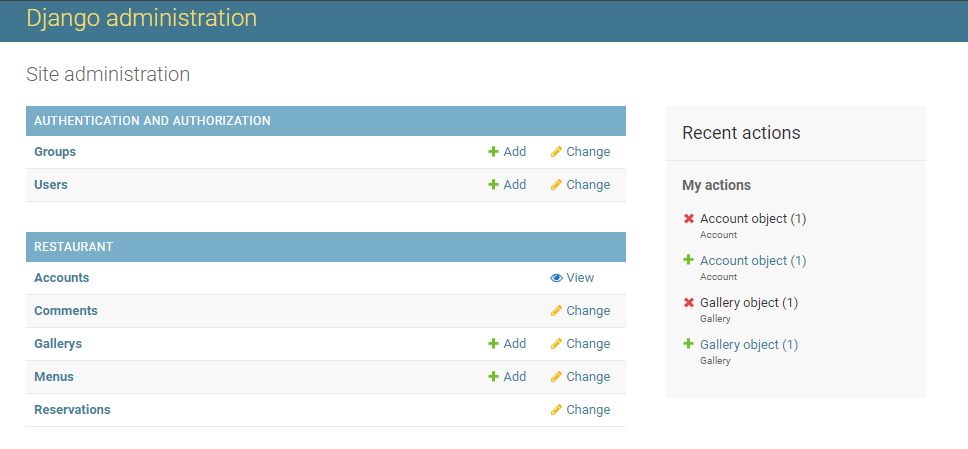
The Django admin interface provides a range of functionality including:
- Fast setup: A fully functional admin panel that is ready to use immediately, reducing the initial time and effort to write software to build the backend.
- Customization options: Extensive customization capabilities to tailor the admin interface to specific business needs and workflows.
- Data management tools: Robust features for managing application data, including creating, reading, updating, and deleting records.
- User and permission management: Tools for efficiently managing user roles and permissions, ensuring secure and controlled access to different parts of the application.
- User-friendly design: An intuitive interface that allows non-technical staff to manage application data effectively, enhancing overall team efficiency.
PRO TIP: Start by utilizing the built-in admin interface for quick data management and prototyping. This allows you to iterate on your core product features faster, gather user feedback early, and make data-driven decisions without extensive custom web development work. See Our Django Admin Case Study: [News Content Monitoring and Analysis](/news-content-monitoring-and-analysis/)
ORM and database support
Django’s Object-Relational Mapping (ORM) and robust database support offer significant advantages for startups. The ORM simplifies database interactions by allowing developers to work with database records as if they were Python objects, eliminating the need for writing complex SQL queries.
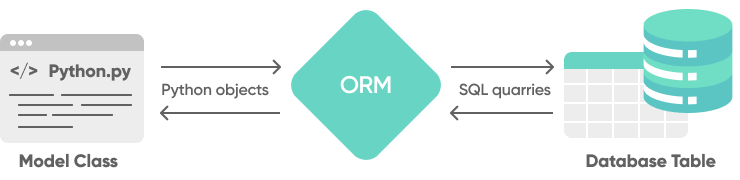
This abstraction layer accelerates development, reduces the likelihood of errors, and ensures a more intuitive and efficient workflow, which is particularly beneficial for startups aiming to launch their products quickly. Key features of Django's ORM and database support include:
- Intuitive ORM: Interact with databases using Python code, making database operations more straightforward and reducing the need for complex SQL queries.
- Multi-database support: Compatibility with various databases like PostgreSQL, MySQL, SQLite, and Oracle offers flexibility in choosing the right database for your startup.
- Database migrations: Built-in tools for managing database schema changes enable smooth updates and iterations without disrupting the development process.
- Query optimization: Efficient query generation and execution ensure that database interactions are performant and scalable.
- Data integrity and security: Built-in features maintain data integrity and enhance security, protecting your application's data from common vulnerabilities.
These components provide significant flexibility, as Django's ORM is designed to support multiple database backends. This flexibility allows startups to choose the database that best fits their needs and scale as they grow. Moreover, Django’s database-agnostic design ensures that applications can switch databases with minimal changes to the codebase, providing the agility needed to adapt to evolving requirements and resources.
PRO TIP: Utilize Django's ORM to streamline database interactions by writing Python code instead of SQL, which accelerates development and reduces errors. Startups can benefit from Django’s support for multiple databases, allowing seamless scalability and easy switching between database backends as business needs evolve, ensuring both flexibility and agility in product development.
Scalability and versatility
For startups, choosing a technology stack that can grow with the business is crucial. Django is one of the most popular web frameworks for both scalability and versatility, making it an ideal choice for startups anticipating rapid growth and diverse application requirements. Django's modular architecture and clean design principles allow developers to build scalable applications that can handle increased traffic and data load without compromising performance. Key features that make Django a great fit for growing startups include:
- Modular architecture: Django’s clean and modular design facilitates easy scaling and maintenance, allowing startups to adapt and expand their applications as needed.
- Reusable components: The framework includes extensive libraries and third-party packages that enable rapid feature development and customization, reducing development time and effort.
- Efficient request handling: Django's built-in mechanisms for managing high traffic and concurrent requests ensure robust performance, even under heavy loads.
- Flexible deployment options: Django's compatibility with various deployment environments, including cloud platforms and traditional servers, offers flexibility in scaling your application to meet growing demands.
- Extensible framework: The ability to integrate with other technologies and services enhances the versatility of Django applications, allowing startups to build comprehensive solutions that meet their specific needs.
Django’s versatility is reflected in its ability to support a wide range of applications, from simple websites to complex, data-driven platforms. The framework’s extensive library of reusable components and third-party packages enables startups to quickly add new features and functionalities as their needs evolve. Whether it's integrating with external APIs, implementing advanced data analytics, or building sophisticated user interfaces, Django provides the tools and flexibility required to meet diverse business demands.
PRO TIP: Design your Django applications with scalability in mind from the start. Utilize Django’s modular architecture and reusable components to build a solid foundation that can handle future growth. Regularly review and optimize your codebase to ensure it remains efficient and scalable as your user base expands.
6 cons of Django for startups
Despite its many strengths, Django also presents some challenges that startups need to consider. These drawbacks can impact the development process and overall efficiency, particularly for specific types of projects or requirements. Here, we outline the main cons of using Django to help startups make an informed decision, with real-world mitigations I’ve seen work time and again at SoftKraft.

Initial learning curve
One of the challenges that startups may face when adopting Django is the initial learning curve of the web framework. Django is a comprehensive and feature-rich framework, which means that new developers can find it overwhelming at first. The extensive documentation, while thorough, can be daunting for beginners who are unfamiliar with Django’s conventions and best practices. This steep learning curve can result in a slower start as the development team invests time in understanding the framework's intricacies and setting up their development environment correctly.
However, it’s important to note that this learning curve is often a one-time issue. Once the development team becomes proficient with Django, the benefits of its robust features and efficient workflows typically outweigh the initial time investment. Startups should consider the initial learning curve as a short-term cost that can lead to long-term gains in productivity and development speed. By overcoming the initial learning challenges, startups can maintain development velocity, ensuring that their projects progress smoothly and efficiently in the long run.
PRO TIP: To mitigate the initial learning curve, consider outsourcing the initial development to a team of experienced Django developers. This approach can accelerate the setup process, provide a robust foundation for your project, and allow your internal team to learn from seasoned professionals.
Learn more about our Python Development Outsourcing
Overhead for small projects
While Django is a powerful and comprehensive framework, it can sometimes be overkill for small projects. The extensive features and built-in functionalities that make Django so effective for larger applications can introduce unnecessary complexity and overhead for simpler, smaller projects. Startups working on smaller projects might find that the setup and maintenance of Django come with a higher resource requirement than lighter-weight frameworks or tools.
However, if your startup plans to develop an early proof of concept (POC) or minimum viable product (MVP) with the intention of building on top of it later, Django can be an excellent choice. Its scalability and robust feature set will support future growth and feature additions without needing to switch frameworks. On the other hand, if your project is meant to remain small and you do not intend to expand its functionality or user base significantly, Django might not be the most efficient choice. In such cases, the additional setup time and resource allocation could detract from the agility and speed that small startups often need.
Examples of projects that might not be suitable for Django include:
- Simple static websites: Basic websites with minimal interactivity and static content can be better served by basic systems that do not require the full capabilities of Django.
- Small single-page applications (SPAs): Lightweight SPAs that rely heavily on frontend frameworks like React or Vue.js.
- Microservices: Small, isolated services that require minimal server-side logic and can be handled by micro-frameworks like Flask or FastAPI.
- Landing pages: Simple landing pages or marketing sites that do not require the full capabilities of a comprehensive framework.
By carefully assessing the project's requirements, startups can choose the most appropriate technology stack to maintain agility and ensure efficient resource use.
PRO TIP: Consider hiring our dedicated software development team to help with architecture development and technology selection. Expert advice can ensure that your startup chooses the most appropriate tech stack for your project's specific needs, balancing functionality, and efficiency to avoid unnecessary overhead.

Performance concerns
Another potential drawback of using Django for startups is related to performance concerns. While Django is highly capable and versatile, it may not always deliver the optimal performance for extremely high-load applications or real-time data processing tasks out of the box.
The abstraction layers and built-in functionalities, which provide convenience and speed during development, can sometimes introduce performance bottlenecks that require additional optimization. In particular, the following types of applications can be challenging for Django without proper tuning:
- High-concurrency applications: Handling a large number of simultaneous user requests might lead to performance bottlenecks without proper optimization.
- Real-time data processing: Tasks requiring immediate processing and low-latency responses may require additional tools like Celery or Redis.
- Heavy computational loads: Applications involving complex computations or large data manipulations might experience slow performance if not optimized correctly.
- Complex query operations: Inefficient database queries can slow down the application, particularly with large datasets or complex relationships. Optimizing query parameters can enhance the efficiency of these operations.
Without these considerations, startups might face challenges in achieving the necessary performance levels, which could impact user experience and scalability.
Mitigation from experience: The ORM is excellent 90% of the time, but when you hit a performance wall, experienced Django teams know exactly when to drop to .raw() queries, use select_related() / prefetch_related(), or even raw SQL for the heaviest operations. Pair it with Redis caching, database indexing, and proper query profiling, and Django handles production loads at scale just fine.
PRO TIP: When building a proof of concept (PoC) for investors, early performance might not be as critical since the primary focus is to demonstrate functionality and potential. In such cases, Django’s robust features and rapid development capabilities can help you build quickly and impress stakeholders.
However, if you're launching your application to real users, performance becomes crucial. Depending on the specific functionality and use case, you may need to invest in strategic optimization to ensure a smooth user experience. Consider building fast with Django initially and planning for performance tuning and optimization as your user base grows and application demands increase.
Migration challenges
One of the challenges startups might face when using Django is dealing with database migrations. As applications evolve and new features are added, the database schema often needs to be updated. While Django provides a robust migration framework to handle these changes, managing complex migrations can still be a daunting task.
For startups, frequent schema changes are common as the product develops and pivots based on user feedback and market needs. For example, you might need to update your database schema when adding new features like user profiles, implementing a new payment system, or restructuring data to improve performance. These scenarios can lead to complicated migration processes where dependencies, data transformations, and backward compatibility must be carefully managed. Mistakes in this process can result in downtime or data integrity issues, which can be particularly disruptive for a growing startup.
Some of the key challenges in managing database migrations include:
- Complex schema changes: Major changes to the database schema, such as splitting tables to normalize data or changing data types to accommodate new features, can be difficult to manage smoothly. These changes are often necessary when scaling the application or adding significant new functionalities.
- Data transformations: Migrating data to new formats or structures often requires custom scripts and careful planning. For instance, moving from a simple customer table to a more complex CRM system involves detailed data mapping and transformation.
- Dependency management: Ensuring that all dependencies and related services are correctly updated during migrations can be complex and error-prone. This is particularly true when integrating with third-party services or microservices architecture where various components need to stay in sync.
- Backward compatibility: Maintaining compatibility with existing code and data while implementing migrations can add additional layers of complexity. For example, ensuring that old user data remains accessible after a major update to the user management system is critical for a seamless user experience.
Mitigation from experience: Treat migrations as first-class citizens. Use django.db.migrations with data migrations, run them in staging with realistic data volumes, and always have rollback plans. Tools like django-migration-linter and automated CI/CD checks catch most issues before they hit production.
PRO TIP: Implement Continuous Integration and Continuous Deployment (CI/CD) practices to streamline your database migration process. By automating testing and deployment, you can catch issues early and ensure that every change is thoroughly validated before it reaches production. This reduces the risk of downtime and data integrity issues, allowing your startup to iterate quickly and confidently.
Learn more about CI/CD best practices and our DevOps consulting services.
Tight coupling of components
One of the potential downsides of using Django is the tight coupling of its components. Django's design philosophy emphasizes convention over configuration, which can lead to a highly integrated system where various components, such as models, views, and templates, are closely interlinked. While this approach can streamline development and reduce boilerplate code, it can also introduce challenges when flexibility and customization are required.
For startups, this tight coupling can become a limitation when the application needs to evolve in unexpected directions. Customizing or replacing certain parts of the framework can be complex and time-consuming, as changes in one component often necessitate changes in others. This can make it difficult to adapt quickly to new requirements or integrate with other technologies that do not fit neatly into Django's ecosystem.
Some challenges you may face include:
- Custom integrations: Integrating third-party services or libraries that do not align with Django's architecture can be cumbersome.
- Component replacements: Replacing built-in components, such as the ORM or template engine, with alternatives may require extensive modifications.
- Scalability constraints: Scaling specific parts of the application independently can be challenging due to the interdependencies of Django components.
Mitigation from experience: The framework’s “magic” is powerful, but smart teams design with loose coupling in mind from day one: heavy use of signals, custom managers, middleware, and service layers keeps the monolith flexible without fighting Django’s conventions.
Limited asynchronous support
While Django is a powerful and versatile framework, one of its notable limitations is its limited asynchronous support. This can be a significant drawback for startups that need to build highly performant, real-time applications. Django’s traditional request-response cycle is synchronous, meaning that each request must be processed in its entirety before moving on to the next.
This can lead to performance bottlenecks, especially in applications that require real-time data processing or handle numerous concurrent connections, such as chat applications, live notifications, or online gaming platforms. The limited asynchronous capabilities can make it challenging to efficiently manage large volumes of simultaneous requests, resulting in slower response times and potentially impacting user experience.
Mitigation from experience: Django 4.1+ and especially 5.x have improved async support (ASGI, async views), but for heavy real-time needs we reach for Django Channels + Redis or offload to Celery/Redis queues. Many teams also layer FastAPI for specific async-heavy microservices while keeping the main app in Django.
Django framework vs other frameworks
Django is often compared with other popular frameworks like Node.js, Flask, and Ruby on Rails. Each framework has its strengths and weaknesses, making them suitable for different types of projects and development teams. Below, we compare Django with these other frameworks to help you determine the best fit for your startup.
Django vs. Node.js
| Django | Node.js | |
|---|---|---|
| Language | Python | JavaScript |
| Architecture | Model-View-Template (MVT) | Event-driven |
| Performance | Good | Excellent for real-time apps |
Django is built on Python, which is praised for its readability and ease of use. Node.js uses JavaScript on both the server-side and client-side, which can be advantageous for developers familiar with JavaScript. One key difference lies in their architectures: Django follows the Model-View-Template (MVT) pattern, whereas Node.js tends to follow an event-driven architecture.
When it comes to performance, Node.js often has an edge due to its non-blocking, event-driven nature. This makes it suitable for applications needing real-time capabilities, such as chat applications. Conversely, Django excels in use cases where scalability and rapid development are critical.
Read More: Django vs Node.js - How to Make the Right Decision in 2024?
Django vs. Flask
| Django | Flask | |
|---|---|---|
| Built-in Tools | Comprehensive | Minimal |
| Flexibility | Less flexible | Highly flexible |
| Learning Curve | Steeper | Easier |
Django is a high-level framework that comes with many built-in features like an authentication system, admin interface, and ORM. This makes it ideal for developers who want to get up and running quickly without needing to implement these from scratch. Flask, on the other hand, is a micro-framework, which means it provides the essentials but leaves many choices to the developer.
Flask’s minimalistic approach makes it highly flexible and lightweight, giving developers more control over components. However, this flexibility can lead to more effort in the initial setup and configuration. For startups, choosing between Django and Flask usually involves a trade-off between rapid development and flexibility.
Django vs Ruby on Rails
| Django | Rails | |
|---|---|---|
| Language | Python | Ruby |
| Development | Convention with some flexibility | Convention over configuration |
| Deployment | Easier for newcomers | More complex |
Both Django and Rails are opinionated frameworks that come with a lot of built-in tools to support rapid development. Rails, built on Ruby, follows the Convention over Configuration principle, which means it makes many decisions for you to simplify the development process. Django also has a similar approach but gives a bit more freedom in certain aspects.
The deployment ecosystem for Rails can be more complex due to different server and setup requirements, whereas Django, with its extensive documentation, can be easier for newcomers to deploy. Performance-wise, both frameworks are comparable, but specific requirements and the familiarity of Rails developers with Ruby or Python can make a significant difference.
Django vs. FastAPI (for API-first or microservice startups)
When I recommend FastAPI instead of Django to a startup:
- Pure API backends serving mobile or SPA frontends
- Heavy real-time or WebSocket requirements
- Teams that want maximum performance and async from day one
- Microservices architecture where each service is small and focused
FastAPI gives you automatic OpenAPI docs, Pydantic validation, and native async support with Starlette. It’s lightning fast and modern. However, you lose Django’s batteries-included admin, auth system, ORM migrations, and ecosystem. If your product is more than just an API, Django still wins for speed of feature delivery.
My pragmatic rule of thumb as a Tech Lead: Choose Django when you want to ship business logic fast. Choose FastAPI (or Node.js/Express) when your core value is raw API performance or real-time features.
What SoftKraft recommends: Practical Django checklist for startups
After helping dozens of startups adopt Django, here’s the battle-tested checklist I give every founder:
- Start as a monolith: don’t over-engineer microservices on day one. Django monoliths scale beautifully to millions of users when properly architected.
- Include DRF from the beginning: even if you’re using templates now, you’ll need APIs for mobile or future frontend swaps.
- Add Celery + Redis early: any background job (emails, notifications, exports) should go here immediately.
- Use environment-specific settings with
django-environand separatedevelopment.py/production.py. - Enable Django Debug Toolbar + Silk in dev for immediate performance insights.
- Plan your user model extension strategy on day one:
AbstractUseror custom user model from the start saves painful migrations later.
Follow this checklist and you’ll avoid 80% of the common Django startup pitfalls we see.
Additional Tools and Libraries
When startups choose Django as their web development framework, they often need additional tools and libraries to extend its functionality and meet their specific needs. Here are some essential tools and libraries that complement Django, enhancing its capabilities and making it an even more powerful choice for startups.
Django REST Framework is a powerful and flexible toolkit for building Web APIs. It is highly recommended for startups looking to develop RESTful APIs quickly and efficiently. DRF provides a wide range of features, including serialization, authentication, and viewsets, which simplify the process of creating robust APIs.
Benefits: Simplifies API development, supports authentication and permissions, and provides powerful serialization options.
Use case: Ideal for startups building APIs to serve mobile apps, single-page applications, or integrating with third-party services.
Celery is an asynchronous task queue/job queue based on distributed message passing. It is perfect for handling background tasks and scheduling periodic tasks, which can significantly improve the performance and scalability of Django applications.
Benefits: Handles asynchronous tasks, schedules periodic tasks, and improves application performance.
Use case: Suitable for startups needing to process background tasks like sending emails, processing files, or performing time-consuming computations.
Django Channels extends Django to handle WebSockets, allowing for the development of real-time applications. It integrates seamlessly, making it easier to add real-time functionality to your Django project.
Benefits: Enables real-time communication, supports WebSockets, and integrates well with Django.
Use case: Ideal for startups building chat applications, live notifications, or any application requiring real-time updates.
Conclusion
Django stands out as a robust, scalable, and efficient framework for startups. Its comprehensive feature set, strong community support, and rapid development capabilities make it an ideal choice for building modern web applications. While there are some challenges, such as the initial learning curve and performance concerns, the benefits almost always outweigh the drawbacks when you know how to work with the framework rather than against it.
From my experience advising startups at SoftKraft, Django gives you the fastest path to a maintainable, production-ready product that can actually grow with your business. Pair it with the right practices and complementary tools, and you’ll have a foundation that supports you from MVP all the way to scale-up. If you’re evaluating Django for your next startup project, I’d be happy to jump on a call and help you make the right call for your specific context.