
7 Proven Django SaaS Development Shortcuts to Get a Head Start
Quick Answer: The fastest safe route to a Django SaaS is to reuse Django’s authentication, ORM, admin, migrations, and security middleware; use a proven boilerplate only for commodity features; and make early decisions about tenant isolation, asynchronous work, observability, and deployment. Pair Django with PostgreSQL, Django REST Framework, Celery backed by Redis or Amazon SQS, CI/CD, and AWS security controls so early speed does not become production debt.
Django is a pragmatic backend for B2B SaaS products that need transactional workflows, permissions, integrations, and a predictable Python codebase. Audit trails still require an explicit data model, logging approach, or supporting package. This is a guide to shortcuts without rework: for founders and CTOs, “faster” means reducing work that does not differentiate the product—not skipping architecture. The seven shortcuts below preserve an upgrade path from MVP to a multi-tenant production service and connect to Django AI development, MVP delivery, and web application architecture.
Why do CTOs choose Django for a SaaS backend?
Django is a strong fit when the team needs to ship business workflows without assembling every platform capability from separate packages. Its value is the combination of conventions: an ORM and migrations, authentication and permissions, an admin interface for back-office operations, form validation, middleware, and well-understood security defaults. PostgreSQL is a common production choice, but Django supports other database backends too.
- Transactional domain model: Django ORM, database constraints, and migrations make it practical to model subscriptions, entitlements, invoices, tenant membership, and approval workflows.
- Secure web defaults: Django provides protections against common web risks such as SQL injection, cross-site scripting (XSS), cross-site request forgery (CSRF), and clickjacking. Production systems still need least-privilege IAM, secrets management, logging, backups, and access reviews.
- Integration layer: Django REST Framework (DRF), a widely used third-party package, can expose APIs with an explicitly configured versioning policy for React or mobile clients. Celery workers, backed by Redis, RabbitMQ, or Amazon SQS, can handle email, imports, report generation, and long-running API calls outside the request-response path.
- Operational compatibility: A containerized Django service can run on AWS ECS or EKS with Amazon RDS for PostgreSQL, S3 for objects, CloudWatch for logs and metrics, and Secrets Manager for credentials.
- Business operations: Django admin is useful for controlled back-office workflows, provided that staff access uses SSO or strong MFA, role-based permissions, and audit logging where compliance requires it.
Which Django shortcuts reduce SaaS delivery time without creating rework?
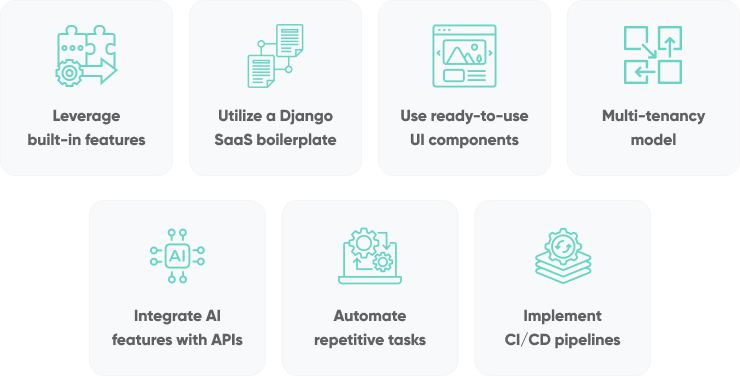
Use the shortcuts selectively. A team can safely standardize common platform capabilities, but should explicitly design the data model, tenant boundary, integration contracts, and deployment controls that affect customer trust and cost.
Leverage Django’s built-in features
Start with Django capabilities that remove undifferentiated work. Build custom domain services around them rather than replacing them with custom abstractions before product requirements are clear.
- Django ORM and migrations: define constraints, indexes, relationships, and schema changes as code. Review query plans for high-volume endpoints rather than assuming the ORM produces efficient SQL.
- Authentication and authorization: begin with Django users, groups, and permissions; add object-level authorization only where the tenant or resource model demands it.
- Django admin: accelerate support and operations workflows, but restrict it to authorized staff and treat admin actions as production changes.
- Django REST Framework: use this third-party package to create explicit serializers, validation, pagination, throttling, and a deliberately configured versioning policy for public or partner-facing endpoints.
- Caching and static assets: use Redis for appropriate cache or task-broker workloads and serve static/media assets through S3 and a CDN instead of application containers.
When to consider FastAPI: FastAPI can be a good fit for a standalone, API-first service with high I/O concurrency, streaming workloads, or model-inference endpoints. It is not automatically faster for an entire B2B SaaS: database access, integrations, and product architecture are often the actual bottlenecks, and Django supports ASGI and asynchronous views. Avoid adding FastAPI to a Django product for only a few endpoints, since that creates a second stack for authentication, authorization, validation, deployment, and observability. Use it when the service boundary is independently valuable.
Architecture checkpoint: Document which rules and audit events live in models, service-layer functions, API serializers, and asynchronous workers. Clear boundaries prevent business logic from drifting into views, admin actions, and one-off scripts.
Use a Django SaaS boilerplate selectively
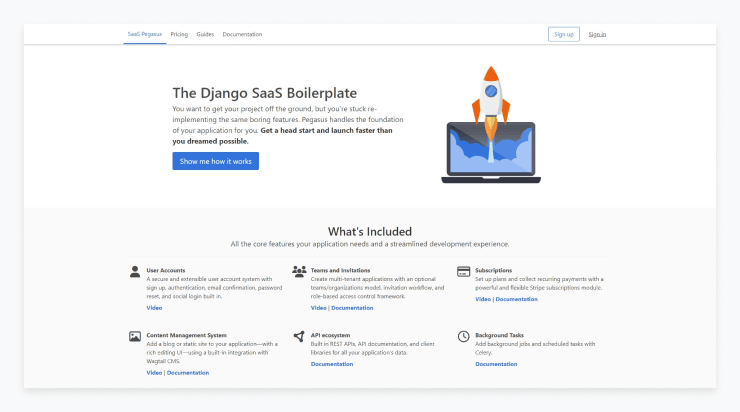
A boilerplate can accelerate setup when it supplies commodity capabilities such as account management, billing integration, teams, email, and deployment configuration. It is not a substitute for a domain model, security review, or tenant-isolation design. Before adopting one, verify its Django and Python version support, dependency maintenance, test coverage, license, payment-provider integration, and upgrade path.
Examples include SaaS Pegasus and AI SaaS Template. Keep only components that match product requirements. Replacing a boilerplate’s conventions wholesale after launch often costs more than building the necessary narrow feature first.
Define the subscription and entitlement model before building the billing UI. The application must decide which plan grants which capability, where usage is measured, and what happens after payment failure, cancellation, or a delayed webhook. If Stripe is used, process subscription events through a verified, idempotent webhook endpoint; Stripe’s current subscription webhook guidance covers status changes and payment events.
Architecture example: SoftKraft built ExpiredLinks, a cloud SaaS for a digital marketing agency, with Python, Django, PostgreSQL, a payment gateway, and integrations with Ahrefs and Moz. The project illustrates a useful boundary: Django owned the product workflow and data model, while specialist APIs supplied external domain and backlink data.
Decision rule: Use a boilerplate for features customers do not buy from you. Write bespoke code for the workflow, data model, integration, or algorithm that defines the product’s value.
Read More: 9 Proven Shortcuts for Faster SaaS Application Development
Use ready-to-use UI components
Ready-to-use UI components reduce delivery time when they standardize accessible controls, forms, navigation, tables, and empty states. Choose the UI approach early: Django templates suit server-rendered workflows and internal tools, while React or Next.js can suit a richer client application or independently versioned frontend. The component library should match that rendering strategy and the team’s design-system discipline.
Adopt a small, documented component set and add visual regression or end-to-end tests for critical flows such as sign-up, checkout, role assignment, and data export. This gives the product a consistent UI without making every screen dependent on custom CSS or untested widgets.
Choose a multi-tenancy model based on risk
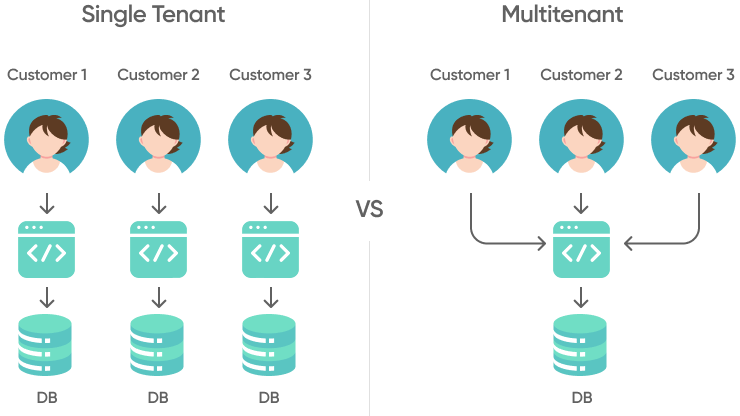
Choose the tenant model before releasing customer data. The right option depends on isolation requirements, compliance obligations, schema customization, analytics needs, and operational cost—not only on the expected number of customers.
Decision matrix
- Shared application, shared database → use for an MVP or many tenants with the same data model and moderate isolation requirements. Cost/risk: lowest operating cost, but tenant scoping must be enforced in every request, worker, admin action, export, and integration.
- Shared application, separate schema → use when tenants need a stronger namespace boundary but can share one database cluster. Cost/risk: more complex migrations and routing; less operational isolation than independent databases.
- Shared application, database per tenant → use for enterprise customers that need stronger data or backup separation. Cost/risk: higher connection-management, migration, reporting, and operational-automation overhead. A separate database alone does not establish data residency: choose the correct region and account for replicas, backups, logs, and encryption keys.
- Separate application and database per tenant → use when contracts, regulations, performance isolation, or customer-specific releases justify dedicated environments. Cost/risk: highest infrastructure and support burden because every deployment, monitoring path, and incident response process is multiplied.
For sensitive B2B data, document the boundary in an architecture decision record and test authorization at API, worker, admin, and export paths. In a shared PostgreSQL database, Row-Level Security policies can add database-level defence in depth; policies must be designed deliberately because table owners and privileged roles can bypass them. Tenant isolation is a security property, not a filter added only to the main list view.
Integrate AI APIs through controlled workflows
Managed AI APIs can shorten time to a useful feature, but Django should coordinate a controlled workflow rather than send unrestricted customer data to a model. Start with one measurable use case: document classification, extraction, search augmentation, support triage, or image moderation. Define the input contract, retention policy, human-review route, latency budget, and evaluation set before exposing the feature to customers.
Typical integrations include:
- Amazon Textract for OCR and structured extraction in intelligent document processing (IDP) pipelines.
- Amazon Rekognition for image and video analysis when the product requires it.
- Amazon SageMaker for managed model training and inference where a custom ML lifecycle is justified.
- Google Cloud Speech-to-Text for transcription workflows.
- LLM providers for bounded summarization, classification, or retrieval-augmented generation (RAG), with tenant-aware retrieval, prompt-injection controls, output validation, and traceable evaluations.
Automate repeatable Django development tasks
Automate repeatable, reviewable work first. The objective is to make delivery and operations reproducible, not to hide production actions behind scripts without controls.
- Management commands: package imports, reconciliation, data repair, and backfills as idempotent Django commands with dry-run support, logs, and explicit tenant scope.
- Asynchronous jobs: move email, webhooks, exports, report generation, and large imports to Celery workers with a broker such as Redis, RabbitMQ, or Amazon SQS. Make tasks idempotent and use retry policies that do not duplicate financial or customer-facing actions.
- Quality gates: run Ruff, formatting, type checking where adopted, unit tests, integration tests, and dependency scanning in pull requests.
- Dependency control: use pip-tools or Poetry to lock dependencies and make builds reproducible across developer, CI, and production environments.
- Infrastructure as code: version AWS resources, IAM policies, and environment configuration through Terraform, AWS CDK, or an equivalent reviewed workflow.
Implement production-ready CI/CD validation
A Django CI/CD pipeline should produce evidence that a release is deployable, not merely copy code to production. Use GitHub Actions, CircleCI, or the organization’s existing platform to run a consistent sequence for every pull request and protected deployment.
- Run unit, integration, and API contract tests against a disposable PostgreSQL service.
- Run
python manage.py check --deployagainst production-like settings and apply migrations in a staging-like environment before production. - Scan dependencies and container images; block known critical issues according to an agreed risk policy.
- Store runtime secrets in a managed service such as AWS Secrets Manager, not configuration files. For CI/CD, prefer workload identity or OIDC and short-lived credentials over long-lived repository secrets; restrict retrieval through least-privilege IAM roles and rotate credentials where feasible.
- Deploy with a rollback plan, health checks, structured logs, error tracking, and dashboards for latency, error rate, queue depth, and database saturation.
For regulated B2B systems, retain deployment approvals, change history, and access logs as compliance evidence. These controls support SOC 2, ISO 27001, and customer security reviews, but they do not by themselves establish certification.
When should a SaaS team involve a Django development partner?
External engineering support is most valuable when the team needs to validate a SaaS architecture, recover a delayed product, integrate AI or third-party systems, improve reliability, or prepare for enterprise security due diligence. A useful discovery process produces explicit deliverables: a domain and tenant model, integration inventory, delivery milestones, cloud cost assumptions, security risks, and measurable acceptance criteria.
SoftKraft’s Python development team can help define and build a scalable SaaS software solution across Django, PostgreSQL, DRF, AWS, and AI-enabled workflows. The engagement should be evaluated against product outcomes such as release predictability, operational risk, support effort, and the cost of maintaining the platform after launch.

What is the practical Django SaaS delivery sequence?
Begin with Django’s core features and a clear PostgreSQL domain model. Then choose the tenant boundary, use a boilerplate only for commodity functions, automate asynchronous work and quality checks, and ship through CI/CD with observability and rollback capability. This sequence gives a SaaS team a faster first release while keeping security, performance, compliance evidence, and future AI integrations visible from the start.