

Django vs Node.js: How to Make the Right Decision in 2026
Quick Answer: Choose Django when the product needs a transactional backend with PostgreSQL, Django ORM, Django REST Framework, role-based access, audit trails, and a built-in admin interface—typical for B2B SaaS, fintech, and AI-enabled workflows. Choose Node.js when the workload is I/O-bound, event-driven, or JavaScript-first across React, Vue, or Angular, and you need WebSockets, streaming APIs, or services on Express.js or NestJS. In July 2026, decide from workload shape, team skills, compliance obligations, and integrations—not popularity alone.
Django and Node.js remain two of the most common backend choices in web development, although they are not equivalent categories: Django is a full-stack Python web framework, while Node.js is a JavaScript runtime. In practice, this comparison means Django/Python versus a Node.js backend stack built with Express.js, NestJS, Fastify, or a similar framework. In Stack Overflow's 2025 Developer Survey, Django ranked among the top web frameworks while JavaScript continues to dominate overall usage. For a 2026 product decision, the relevant question is not which stack is more popular, but which runtime and ecosystem match your data model, real-time requirements, compliance scope, and hiring constraints.
- What is Django, and when does its Python architecture fit your product?
- What is Node.js, and when does its event-driven runtime fit your product?
- Django vs Node.js by product type: SaaS, AI, and fintech
- How do you choose between Django and Node.js in six practical steps?
- Define project requirements and workload shape
- Evaluate team expertise and hiring economics
- Compare development speed against long-term flexibility
- Assess scalability, performance, and real-time needs
- Examine ecosystem, integrations, and cloud deployment
- Validate with a prototype or pilot before committing
- Which framework should you choose for your next web application?
What is Django, and when does its Python architecture fit your product?
Django is a high-level, open-source Python web framework built around explicit data models, request handling, security defaults, and reusable application modules. Adrian Holovaty and Simon Willison created Django in 2003; it became public in 2005. As of July 2026, supported Django branches include 6.0 and 5.2 LTS; Django 6.1 remains in development and is expected in August 2026. New products should target a supported branch with a defined patching cadence.
Django fits products that need a coherent domain model, audited database changes, role-based access, and back-office workflows rather than only a thin API layer. Its core components and common ecosystem tools include:
- Django ORM (Object-Relational Mapping): Django includes a robust ORM that maps Python models to PostgreSQL or other relational databases, reducing raw SQL for standard CRUD and reporting queries while preserving access to indexes, transactions, and migrations.
- Django REST Framework (DRF): The Django ecosystem provides this third-party toolkit for building APIs with serializers, viewsets, authentication classes, throttling, and pagination—useful for B2B integrations and mobile clients.
- Django Admin: Django ships with a built-in admin interface for operations teams to manage records, permissions, and audit-sensitive data without building a separate back office from scratch.
In production, a typical Django deployment places the application behind a load balancer, uses PostgreSQL for transactional data, Redis for cache and queues, Celery for background jobs, and object storage such as Amazon S3 for files.
What are Django's main strengths for backend development?
When comparing Django and Node.js, evaluate each framework against concrete product requirements:
- Python ecosystem: Django runs on Python, giving access to libraries for data processing, machine learning, OCR/IDP pipelines, and scientific computing—relevant for AI-enabled B2B products and fintech analytics.
- Mature, batteries-included design: Django provides ORM, migrations, authentication, CSRF protection, form handling, templating, and admin out of the box—reducing glue code for transaction-heavy SaaS and internal platforms.
- Security defaults: Django includes protections against SQL injection, cross-site scripting (XSS), clickjacking, and common authentication pitfalls—important when handling customer PII or financial records.
- Scalable monolith path: Django supports horizontal scaling behind load balancers, read replicas, Redis caching, and asynchronous workers before a team splits into microservices.
- Rapid delivery for data-centric products: Concurrent work on models, admin, API endpoints, and permissions accelerates MVPs where the domain model is the product differentiator.
What are Django's limitations?
Django is not the default choice for every workload:
- Steeper onboarding for full-stack teams: Django's conventions, project layout, and ORM patterns require more upfront learning than a minimal Express.js service.
- Overhead for tiny prototypes: A full Django project can feel heavy when the deliverable is a single API endpoint with no admin or data model complexity.
- Backend-first orientation: Django does not replace a dedicated frontend framework; React, Vue, or Angular still handle client-side UX for modern SPAs.
- Real-time workloads need extensions: High-frequency WebSocket or streaming workloads may require Django Channels, Redis, or a separate Node.js service rather than synchronous request handling alone.
What is Node.js, and when does its event-driven runtime fit your product?
Node.js is an open-source JavaScript runtime built on Chrome's V8 engine. It enables server-side JavaScript for scalable network applications, API gateways, and real-time services. Node.js fits products where JavaScript is already the primary language on the client and the backend must handle many concurrent, I/O-bound connections with minimal blocking. For production in July 2026, choose an LTS line—Node.js 24 is Active LTS and Node.js 22 is Maintenance LTS—rather than an end-of-life release.
Core characteristics include:
- Asynchronous, event-driven I/O: Node.js uses a non-blocking I/O model suited to chat, notifications, live dashboards, and proxy layers that wait on external APIs or databases rather than CPU-heavy computation.
- Cross-platform deployment: Node.js runs on Windows, macOS, and Linux, simplifying local development and containerized deployment on AWS ECS, EKS, or serverless platforms.
- npm ecosystem: The Node Package Manager (npm) provides access to a large registry of libraries for HTTP servers, validation, authentication, observability, and integration SDKs—often paired with Express.js, Fastify, or NestJS for structure.
What are Node.js's main strengths?
Node.js is often selected when latency-sensitive I/O and JavaScript consistency matter:
- High concurrency for I/O-bound workloads: The event loop handles many simultaneous connections efficiently when work is dominated by network or database waits.
- Flexible service boundaries: Express.js or NestJS can support independently deployable services behind API gateways and message brokers when the product’s domain boundaries and operational maturity justify that complexity.
- JavaScript full stack: Teams using React, Next.js, Vue, or Angular can share types, validation schemas, and tooling across client and server.
- Real-time primitives: WebSockets, Server-Sent Events, and streaming HTTP responses are common patterns for collaboration tools, gaming backends, and live data feeds.
- Large community and hiring pool: JavaScript skills transfer across frontend, backend, and tooling roles—relevant when scaling a product team quickly.
What are Node.js's limitations?
Node.js trade-offs become visible in larger, compliance-sensitive, or CPU-intensive systems:
- Ecosystem dependency churn: npm packages evolve at different speeds and with varying maintenance quality. Teams need dependency pinning, software composition analysis, automated testing, and planned upgrade windows; this is primarily an ecosystem risk, not evidence that Node.js core APIs are inherently unstable.
- Structure is not enforced: Without NestJS or a defined modular architecture, large codebases can accumulate inconsistent patterns and harder-to-audit authorization boundaries.
- CPU-bound work needs separation: Heavy computation, OCR, model inference, or batch analytics should run in worker processes, queues, or Python/Java services—not on the main Node.js event loop.
- Transactional complexity grows with tooling: Complex domain models, migrations, and admin workflows often require additional ORMs (Prisma, TypeORM), custom back-office UIs, and more integration glue than Django provides by default.
Django vs Node.js by product type: SaaS, AI, and fintech
Conclusion first: Django is often a pragmatic choice for B2B SaaS and fintech backends with complex data models, especially when a team benefits from DRF, PostgreSQL, Redis, Celery, and Django Admin. Node.js is often a better fit when the product is JavaScript-native or requires real-time, I/O-bound services. AI-enabled products can combine both: Django for identity, workflows, audit trails, and data governance; Python or Node.js workers for OCR, embeddings, or model calls. The final choice still depends on domain boundaries, integration needs, team capability, and operating model. See Django AI development and SaaS technology stack for stack patterns by scenario.
| Product context | Prefer Django when | Prefer Node.js when | Typical production pairing |
|---|---|---|---|
| B2B SaaS MVP | You need PostgreSQL-backed multi-tenancy, permissions, admin tooling, and a Python team | The product is a JavaScript SPA with a thin API layer and minimal back-office requirements | Django + DRF + PostgreSQL + Redis; or Next.js + Express.js/NestJS + PostgreSQL |
| AI-enabled application | Workflows, tenant isolation, audit logs, and human review queues are core to the product | Real-time streaming UI, WebSocket updates, or a JavaScript-only team owns the full stack | Django for orchestration + Celery workers + object storage; optional Node.js gateway for live UI |
| Fintech / regulated B2B | Transaction integrity, role-based access, audit trails, and Python integrations with risk or analytics libraries matter | Real-time market data feeds, high-frequency notifications, or event-driven microservices dominate | Django + PostgreSQL + encrypted storage + CIAM; or NestJS services with strict schema validation and centralized logging |
For deeper Django-specific guidance, see Django for startups, Django for business software, and Django SaaS development shortcuts.
How do you choose between Django and Node.js in six practical steps?
Some projects have an obvious stack choice; others require structured evaluation across requirements, team skills, delivery speed, scalability, ecosystem fit, and validation. The six steps below translate those dimensions into a decision a CTO or founder can defend to engineering and procurement stakeholders.
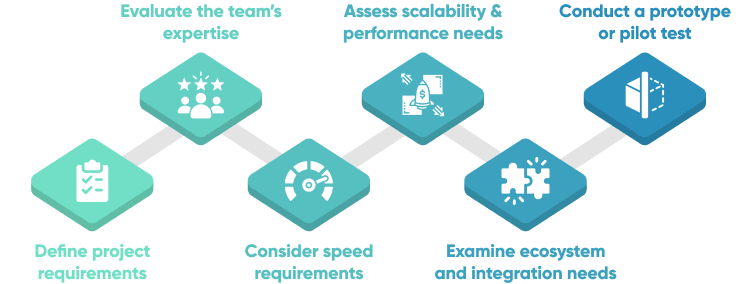
Define project requirements and workload shape
Start with a clear scope document. Define software project requirements before comparing frameworks.
Identify essential functionality: Is real-time chat or live collaboration core to the product? Does the business need a robust admin dashboard for operations? Will the system handle high read/write volume, batch imports, or long-running document processing? Are PCI DSS, PSD2, SOC 2, or GDPR obligations in scope from day one?
How to decide: - If the product requires intricate data models, business rules, permissions, or an operations admin interface, evaluate Django first. - If real-time interactions, streaming APIs, or immediate horizontal scaling of I/O-bound services are primary constraints, evaluate Node.js.
7 Easy Steps to Nail Your Software Requirements Specification
Evaluate team expertise and hiring economics
Framework choice affects delivery speed, defect rates, and the cost of scaling the team. Measure existing proficiency in Python (Django, DRF, Celery) versus JavaScript/TypeScript (Node.js, Express.js, NestJS).
If the organization plans to hire, compare regional availability and fully loaded cost for Python backend engineers versus full-stack JavaScript developers. A slightly slower initial setup on a familiar stack often beats a theoretically optimal stack the team cannot maintain.
How to decide: - If the team has stronger Python experience or access to Python development talent within budget, Django reduces onboarding risk. - If the team is JavaScript-native or hiring full-stack React/Node.js developers is easier, Node.js aligns skills with delivery.
7 Key Elements of Building Software Development Teams
Compare development speed against long-term flexibility
Django's batteries-included design—ORM, migrations, admin, authentication—accelerates MVP delivery when the product is data-centric and back-office workflows matter early.
Node.js with Express.js or NestJS may require more initial scaffolding for migrations, validation, and admin tooling, but offers finer-grained control over service boundaries, middleware, and deployment units—useful when the architecture will evolve into independently scaled microservices.
How to decide: - If time-to-first-production release and operational tooling are priorities, Django often wins for transaction-heavy MVPs. - If the team accepts more upfront architecture work for long-term service decomposition, Node.js is a credible path.
Software Development Planning - Perfect Project Plan in 10 Steps
Assess scalability, performance, and real-time needs
Match the runtime to the bottleneck. Node.js's non-blocking model handles many concurrent I/O operations efficiently—useful for WebSocket gateways, notification services, and API aggregation layers.
Django handles substantial HTTP traffic and complex transactional workloads when paired with PostgreSQL tuning, caching, read replicas, and background workers. For real-time features inside a Django monolith, teams often add Django Channels, Redis pub/sub, or a dedicated Node.js edge service.
How to decide: - If the application depends on persistent real-time connections or I/O-bound concurrency at the edge, prioritize Node.js for that layer. - If the core product is a transactional backend with reporting, permissions, and batch jobs, Django with Celery and Redis is a proven scaling path.
Examine ecosystem, integrations, and cloud deployment
Framework choice affects integration cost with front-end stacks, identity providers, payment gateways, and AWS services.
JavaScript-first products built on React, Next.js, Vue, or Angular often benefit from Node.js API layers that share validation and type definitions with the client. Python-first products integrating with data pipelines, ML libraries, OCR engines, or fintech analytics frequently benefit from Django's Python ecosystem and mature ORM.
How to decide: - If the product is anchored in the JavaScript front-end ecosystem, Node.js reduces context switching and tooling duplication. - If the backend must integrate tightly with Python libraries, PostgreSQL-centric workflows, or AI/IDP pipelines, Django is the stronger default.
12 Dos & Don'ts of Business Web Application Development
Validate with a prototype or pilot before committing
When requirements remain ambiguous, build a bounded prototype of one critical path—authentication, a core API workflow, or a real-time channel—in both stacks or with two competing architectures.
Measure development time, operational complexity, observability setup, and how naturally each stack expresses the domain model. A pilot also tests an outsourcing partner's delivery quality on a contained scope before a long-term engagement.
 Read More:
Which framework should you choose for your next web application?
Conclusion first: Neither Django nor Node.js is universally superior. Django is often the better fit for data-centric B2B SaaS, fintech backends, and AI-enabled products that need PostgreSQL, auditability, admin tooling, and Python integrations. Node.js is often the better fit for JavaScript-native products and real-time I/O workloads; independently deployable services make sense only when the team can operate their added complexity.
Before finalizing the stack, document workload shape, compliance obligations, team skills, integration targets, and a 12-month scaling hypothesis. If the product spans both transactional backends and real-time or AI processing layers, a hybrid architecture—Django for domain logic and Node.js or Python workers for specialized workloads—is often more maintainable than forcing a single runtime to cover every concern.
SoftKraft supports web application development and custom web application development engagements where technology selection, architecture review, and delivery are part of the same engagement—not an afterthought.



![AWS Security Incident Response Plan [Practical Guide]](/uploads/aws-security-incident-response-plan.png)

![Incident Response Plan Template For Startup [SM, MD, XL]](/uploads/incident-response-plan-template.png)