
How Custom LangChain Agents Work - 5 Real Examples
Quick Answer: Custom LangChain agents work by letting an LLM choose the next action, call a tool, inspect the result, and continue until the task is complete. In production systems, this pattern connects Python services, vector databases, APIs, AWS infrastructure, and compliance controls so teams can automate support, procurement, document review, and order workflows without hardcoding every execution path.
LangChain is an open-source framework for building LLM applications that combine model calls with tools, retrieval, memory, and orchestration logic. Instead of sending a single prompt to an LLM, a LangChain application can call Python functions, query a vector database, invoke a REST API, or route work through an agent executor.
This article explains how LangChain agents work and shows five real examples where agentic workflows can support e-commerce, customer service, order processing, supplier discovery, and document analysis. For teams evaluating production AI systems, the key question is not whether an agent is "smart"; the key question is whether the agent can safely decide which tool to use, under what constraints, and with what observability.
Why should CTOs use LangChain for agentic AI systems?
LangChain is useful when an LLM workflow needs controlled access to external context and executable tools. A standard prompt can summarize text, but a LangChain system can retrieve policy documents from a vector store, validate an order in PostgreSQL, call a pricing API, and return a structured answer through a FastAPI backend.
As an open-source framework, LangChain provides abstractions for chains, tools, retrievers, memory, callbacks, and integrations with models such as OpenAI GPT models, Anthropic Claude models, and AWS Bedrock-hosted foundation models. LangChain can be used with Python development teams and JavaScript teams to build applications such as:
- AI chatbots
- Document summarization
- Code analysis
- Data augmentation
- Custom QA systems
- Retrieval-augmented generation (RAG) assistants
- Internal copilots connected to CRM, ERP, or data warehouse APIs
How do LangChain agents work?
LangChain agents act as decision-making loops for workflows where the required sequence of actions depends on user input. A deterministic chain follows a predefined path. An agent evaluates the prompt, selects a tool, passes arguments to that tool, reads the result, and decides whether another action is required.
LangChain applications can be built without agents. Agents are optional and should be used when runtime decision-making is more valuable than a fixed chain. For regulated B2B systems, this distinction matters: deterministic chains are easier to test, while agents need stronger guardrails, logging, tool permissions, and fallback behavior.
The main LangChain components behind agents are:
- Tools - Functions exposed to the agent, such as product search, SQL lookup, CRM update, Google Search, payment validation, or a custom Python service.
- Toolkits - Curated groups of tools for a domain, such as SQL database operations, browser automation, cloud storage, or document retrieval.
- Agents - Reasoning controllers that choose the next tool and action based on user input, tool descriptions, previous steps, and the system prompt.
- Agent executor - Runtime layer responsible for calling the selected tool, passing the tool output back to the agent, enforcing iteration limits, and returning the final answer.
- Memory and retrieval - Context mechanisms that preserve conversation state or fetch relevant knowledge from a vector database such as Pinecone, Weaviate, Chroma, or pgvector.
PRO TIP: Memory is useful, but it should not become an uncontrolled data store. In enterprise implementations, short-term memory usually handles the active conversation state, while long-term context should come from governed retrieval sources with access control, retention policies, and audit logs.
For cloud deployments, teams often combine LangChain with AWS Lambda or ECS, Amazon Bedrock, Amazon OpenSearch, S3, AWS Secrets Manager, and observability through LangSmith, OpenTelemetry, CloudWatch, or Datadog.
What are five real examples of custom LangChain agents?
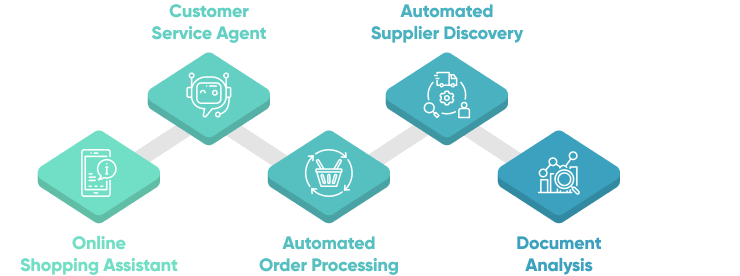
Custom LangChain agents are most valuable when a workflow requires tool selection, external context, and controlled execution. A fixed prompt is enough for a simple answer. An agent becomes useful when the system must decide whether to query inventory, inspect an order, retrieve a contract clause, or escalate to a human.
Below are five real examples that show how custom LangChain agents can work in production-style business systems.
How can a LangChain agent support online shopping?

A custom LangChain shopping agent can translate a natural-language request into structured product search criteria, query a catalog API, retrieve product metadata, and return a recommendation with trade-offs. The agent can use tools for semantic search, inventory checks, pricing, reviews, and personalization.
For example, a shopper on an electronics website asks, "I'm looking for a laptop for gaming under $1,500." The agent extracts GPU, RAM, screen refresh rate, budget, and availability requirements. Then the agent calls a product search tool, filters stock by region, checks promotions, and explains why each result matches the request.
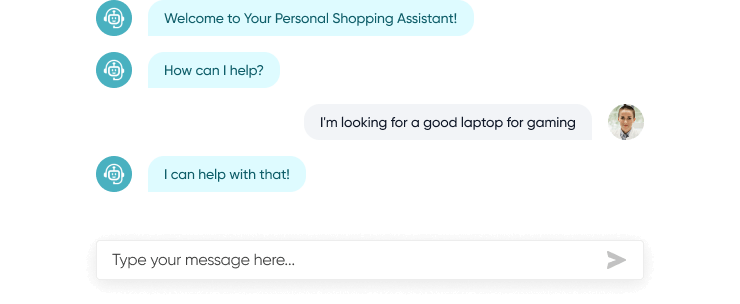
Example:
If you want to implement a shopping assistant chatbot, start with explicit tool contracts instead of exposing raw database access:
import langchain as lc

agent = lc.Agent()

def handle_inquiry(inquiry):
  parsed_inquiry = agent.nlu(inquiry)
  suggestions = agent.suggest(parsed_inquiry)
  insights = agent.insight(suggestions)
  response = agent.response(suggestions, insights)
  return response

example_inquiry = "I'm looking for a laptop that can run games smoothly"
example_response = handle_inquiry(example_inquiry)

print(example_response)
How can LangChain agents automate customer service?
Customer service agents can use LangChain to classify intent, retrieve policy documents, check order data, and produce an answer grounded in approved sources. This is different from a generic chatbot because the response can be tied to tools with specific permissions and traceable outputs.
For example, a customer asks, "What are the available shipping options for my order?" The agent identifies the order ID, checks the destination, calls a shipping options tool, and returns delivery times and costs. If the customer asks, "Can I expedite delivery?", the agent can call the same tool with priority shipping constraints.
For B2B platforms, customer service agents should include role-based access control, PII redaction, escalation thresholds, and a full trace of tool calls. These controls are especially important for GDPR, SOC 2, and ISO 27001-aligned environments.
Example:
If you want to implement a customer service agent, keep the operational logic inside controlled tools:
def shipping_options(customer_question):
    agent = LangChainAgent(nlu=True)

    parsed_question = agent.parse(customer_question)
    order_id = parsed_question["order_id"]
    destination = parsed_question["destination"]

    shipping_methods = agent.query_database(order_id, destination)
    response = agent.generate_response(shipping_methods)
    return response

customer_question = "What are the available shipping options for my order?"
response = shipping_options(customer_question)
print(response)

# Output:
There are three shipping options for your order:
- Standard shipping costs $5 and takes 5-7 business days.
- Express shipping costs $10 and takes 3-5 business days.
- Priority shipping costs $15 and takes 1-3 business days.
To expedite your delivery, please select priority shipping at checkout.
How can LangChain agents support automated order processing?
A LangChain order processing agent can convert a customer request into a controlled transaction flow. The agent should not directly process payments from free-form text. Instead, the agent should collect intent, validate required fields, call payment and fraud tools, and hand off final confirmation to deterministic services.
For example, a customer says, "I'd like to order the new edition hardcover book and pay using my credit card." The agent extracts the product, checks availability, asks for missing delivery details, and triggers a payment verification tool. If payment succeeds, a fulfillment tool creates the order and a notification tool sends confirmation.
The compliance boundary is critical here. Payment card data should be handled by PCI DSS-compliant providers such as Stripe, Adyen, or Braintree, not stored in LangChain memory or logs.
Example:
If you want to implement automated order processing, isolate extraction, payment verification, fulfillment, and messaging:
import re

item_pattern = r"order the (.+?) and"
credit_card_pattern = r"pay using my (.+)"
item_name = re.search(item_pattern, order_text).group(1)
credit_card_number = re.search(credit_card_pattern, order_text).group(1)

payment_status = verify_payment(credit_card_number)

if payment_status:
  confirmation_message = process_order(item_name)
  send_message(confirmation_message)
else:
  notification_message = "Sorry, your transaction could not be completed."
  send_message(notification_message)
How can a LangChain agent automate supplier discovery?
A supplier discovery agent can translate procurement requirements into search filters, query supplier databases, compare certifications, and summarize risk indicators. This is useful when sourcing teams need to evaluate multiple constraints, such as geography, lead time, quality score, ESG requirements, and contract history.
For example, a procurement officer asks, "Can you find a trustworthy supplier for organic cotton fabric?" The agent extracts material, certification, location, price range, and quality thresholds. Then the agent queries supplier records, checks ratings, and returns a shortlist with contact details and evidence for each recommendation.
In production, this agent should not invent supplier facts. It should cite source records, surface missing data, and flag suppliers that lack required certifications or compliance documentation.
Example:
If you want to implement supplier discovery, define criteria explicitly and require the response to reference source data:
def find_supplier():
    agent = LangChainAgent()

    criteria = {"trustworthy": True, "organic_cotton_fabric": True}
    results = agent.query(criteria)

    return [result["name"] for result in results]

suppliers = find_supplier()
print("Here are some trustworthy suppliers for organic cotton fabric:")
for supplier in suppliers:
    print(supplier)
How can LangChain agents analyze contracts and documents?
A document analysis agent can inspect contracts, policies, invoices, medical forms, or compliance evidence by combining OCR, retrieval, clause classification, and structured extraction. The agent can identify non-standard clauses, missing sections, risky terms, and required human review.
Imagine a company receives a non-disclosure agreement from a potential partner. Before signing, the legal team runs the NDA through a document analysis assistant. The agent retrieves the company's approved clause library, compares the NDA against standard language, and flags deviations such as unusual liability terms, broad confidentiality scope, or missing governing law.
For regulated workflows, the agent should produce a structured report with citations to document sections, confidence scores, and review status. If the system processes personal data, the architecture should include GDPR-compatible retention, encryption, and access logging.
Example:
If you want to build a document analysis tool, the agent should return a report that can be reviewed by a human expert:
import langchain

nda = open("nda.txt").read()

agent = langchain.Agent(mode="document_analysis")
report = agent.analyze(nda)

print(report.summary)

if report.non_standard:
    print("Warning: The document contains non-standard terms or clauses.")
    print(report.non_standard)
else:
    print(
        "The document is standard and does not contain any suspicious "
        "or non-standard terms or clauses."
    )
What are the main risks when using LangChain agents?
LangChain agents introduce operational risk because the execution path can change at runtime. Teams should design agentic workflows with strict tool boundaries, deterministic validations, and observability from the first prototype.
Common implementation risks include:
- Data privacy and security: Agent memory, logs, prompts, and tool outputs can expose personal data, trade secrets, or regulated records if access control and retention policies are weak.
- Reliability of data sources: Retrieval quality depends on source freshness, metadata, chunking strategy, embeddings, and permissions. Poor source governance leads to wrong answers.
- Tool misuse: An agent can call the right tool with the wrong arguments. Production systems need input validation, tool allowlists, rate limits, and human approval for high-impact actions.
- Model bias and hallucination: LLM outputs can reflect training data bias or invent unsupported claims. Grounded responses, citations, and refusal policies reduce this risk.
- Scalability and cost: Agent loops can multiply model calls. Teams should define iteration limits, caching, streaming, queueing, and cost monitoring before scaling traffic.
- Auditability: Enterprise buyers often need traceable decisions for SOC 2, ISO 27001, HIPAA, PCI DSS, or GDPR-aligned environments. Tool traces and immutable logs are part of the architecture, not optional extras.
What is the practical takeaway for LangChain agent development?
Custom LangChain agents are a good fit when a business process needs dynamic tool selection, retrieval, and multi-step reasoning. They are not a replacement for deterministic software engineering. The strongest implementations combine agent flexibility with typed APIs, testable tools, observability, access control, and human review for sensitive decisions.
If you are evaluating LangChain, RAG, or AI agent architecture for a production system, SoftKraft can help through AI development services and Python-based implementation support. You can also contact SoftKraft to discuss a custom AI roadmap, cloud architecture, and integration plan.