
Enterprise AI Transformation: 8 Steps to Maximize Impact
Quick Answer: Enterprise AI transformation succeeds when an organization treats AI as a change to data, workflows, controls, and operating metrics—not as a collection of chatbot pilots. Start with a measured readiness assessment, select a small number of high-value workflows, build secure data and integration boundaries, and scale only after proving business impact. For regulated B2B teams, governance, audit evidence, and human review must be designed before production deployment.
Enterprise AI adoption is broad, but scaled value remains difficult. In McKinsey's 2025 global survey, 88% of respondents reported AI use in at least one business function, while roughly one-third had begun scaling AI programs. The gap matters: a CTO needs a roadmap that connects a use case to trusted data, an integration pattern, controls, ownership, and a measurable P&L or operational outcome.
- What does enterprise AI adoption look like in 2026?
- How can a CTO maximize enterprise AI transformation impact?
- How do you assess enterprise AI readiness?
- How do you build an AI roadmap that funds the right use cases?
- How do you make data and AI part of day-to-day operations?
- Which governance controls are required before production AI?
- Should you buy, configure, or build an AI solution?
- Which AI skills should be developed across departments?
- How do you measure ROI and scale AI safely?
- How do you keep the AI program adaptable as technology changes?
- What should happen first?
What does enterprise AI adoption look like in 2026?
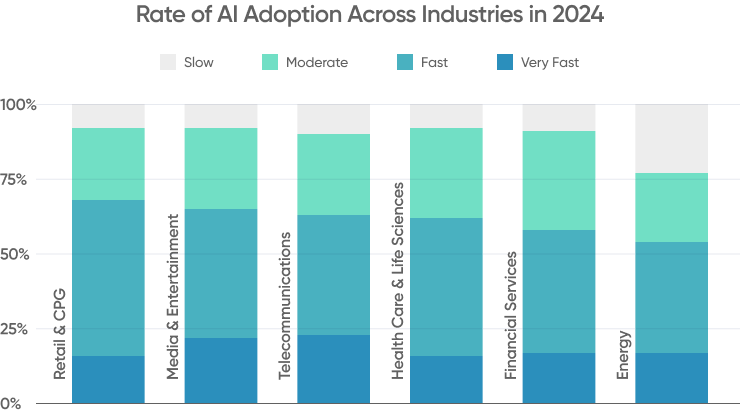
AI is now a mainstream technology investment, not evidence that every use case is production-ready. The Stanford AI Index 2025 reports that 78% of surveyed organizations used AI in 2024, up from 55% in 2023. The same report notes that reported cost savings and revenue gains are often below 10% and 5%, respectively. Workflow redesign, baseline measurement, and adoption ownership matter more than model selection alone.
For an enterprise, a production AI system usually includes more than an LLM or predictive model: governed source data, ingestion and quality controls, an API or event-driven integration layer, evaluation and observability, access controls, and a human escalation path.
For document-heavy operations, that stack might combine OCR or Intelligent Document Processing (IDP), validation rules, a retrieval-augmented generation (RAG) service, and a case-management queue. For forecasting, it might use a feature pipeline, a model registry, batch scoring, and drift monitoring. The architecture should follow the decision and its risk profile; not every problem needs an agent or a foundation model.
For example, an accounts-payable IDP workflow can extract invoice fields with OCR, validate suppliers and totals against ERP data, route low-confidence records to an approver, and write approved entries back to the finance system. Measure straight-through processing rate, exception rate, validation accuracy, and cost per invoice against the pre-AI baseline.
How can a CTO maximize enterprise AI transformation impact?
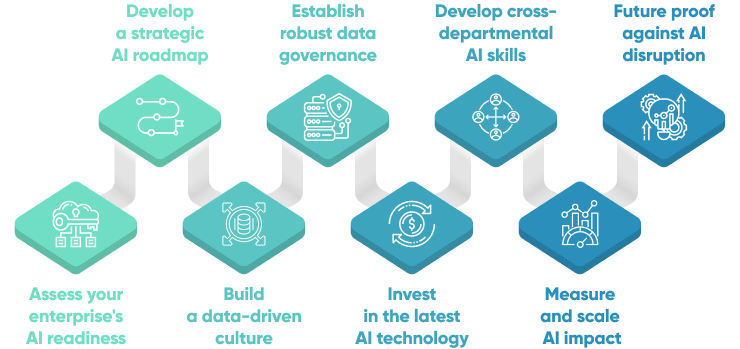
Use the eight steps below as decision gates. Each gate should produce an artifact that business, engineering, security, and compliance stakeholders can review.
How do you assess enterprise AI readiness?
Assess readiness before buying a platform or approving a proof of concept. The output should be an evidence-based scorecard covering data, architecture, security, operating model, and economics. A use case that cannot name its source systems, data owner, success metric, and escalation path is not ready for production.
Can the organization provide trusted, accessible data?
Begin by examining your data quality and the processes governing data collection, storage, and management within your organization. Consider these factors:
- Quality and coverage: Measure completeness, freshness, duplicate rate, and label quality for the target workflow. For RAG, test retrieval relevance and source citation coverage; for ML, test training-serving consistency and feature availability.
- Access and lineage: Identify system owners, permissions, retention periods, and the route from source to model or prompt. Use least-privilege IAM roles and separate production data from experimentation.
- Data governance: Define master-data rules, classification, consent or other lawful basis where applicable, and an audit trail.
Is the operating model ready to own the outcome?
Map named responsibilities: executive sponsor, product owner, data owner, engineering owner, security lead, and legal or compliance reviewer. Review previous automation, data, and cloud programs for delivery bottlenecks. The objective is not an abstract maturity score; it is a realistic decision on whether to run a discovery, a constrained pilot, or a production implementation.
How do you build an AI roadmap that funds the right use cases?
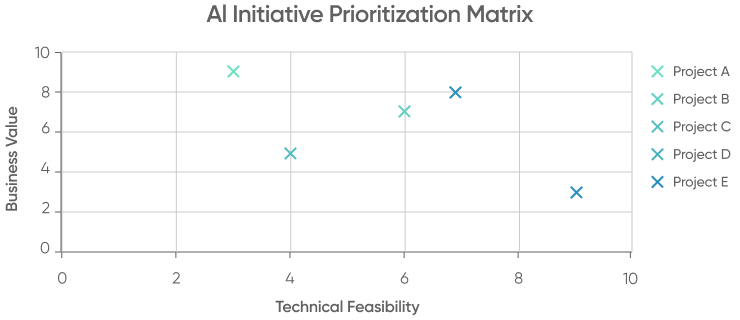
Prioritize a portfolio, not a backlog of ideas. For every candidate, define the affected workflow, baseline cost or cycle time, expected benefit, data dependencies, integration complexity, regulatory exposure, and failure impact. Rank candidates using business value, feasibility, time to evidence, and risk.
Start with bounded, observable workflows: invoice or claim extraction, knowledge retrieval with source citations, support triage, engineering copilots, or anomaly detection. Establish a control group or pre-launch baseline. Then approve scale-up only when the result is repeatable across teams and the operating cost—including inference, review, integration, and support—is understood.
Decision rule: A high-value idea with inaccessible data or an unowned business process should enter a readiness backlog, not a delivery sprint. A lower-risk workflow with measurable volume and a clear owner often produces stronger evidence for the next investment.
How do you make data and AI part of day-to-day operations?
Data culture is operational when teams can explain which metric they own, where it comes from, and when it is safe to act on an AI output. Publish definitions for critical metrics and data products, assign owners, and include data quality failures in normal incident and delivery routines.
Put those principles into operating practice:
- Assess data maturity: Review data management, integration, analytics sophistication, and governance before assigning a workflow to AI.
- Give domain teams approval roles: Business owners should validate prompts, business rules, evaluation cases, and exception handling.
- Teach safe use: Users must know how to verify outputs, report failures, and avoid entering restricted information into unapproved tools.
- Treat feedback as production data: Human corrections, data contracts, and documentation are assets required for reliable AI improvement.
Data engineering for production AI workloads

Which governance controls are required before production AI?
Governance makes an AI system traceable and safe to operate. Establish the controls before connecting a model to customer data, internal tools, or an action-taking agent.
The required controls depend on sector, geography, and risk classification. Legal and compliance teams should validate the applicable obligations.
How do you secure data, prompts, and integrations?
Classify and minimize data before it reaches a model or vector index. Encrypt data in transit and at rest, use least-privilege access, and retain audit logs.
When an LLM can use RAG sources, APIs, or operational tools, test for prompt injection and unsafe tool calls. In AWS, typical building blocks are scoped IAM roles, KMS, Secrets Manager, CloudTrail, and CloudWatch or OpenTelemetry. Python services must validate tool inputs and enforce authorization server-side.
How do you create evidence for model risk and compliance?
Maintain a system inventory, intended-use statement, data lineage, vendor assessment, evaluation results, release approvals, and an incident process. The NIST AI Risk Management Framework is a voluntary structure for governing, mapping, measuring, and managing AI risk.
As of July 2026, EU organizations should already account for AI literacy and prohibited-practice requirements under the EU AI Act. Transparency and high-risk-system duties follow phased applicability dates, so confirm the system classification and the official timetable with legal counsel before release.
Use human review for decisions that can materially affect people, customers, safety, or regulated outcomes. “Human in the loop” is meaningful only if the reviewer has the context, authority, time, and escalation mechanism to override the output.
Control evidence to retain: approved use case, data-flow diagram, vendor DPA or security review, access model, evaluation report, prompt and tool-change history, and owner for incidents and retraining.
Should you buy, configure, or build an AI solution?
Choose an approach per workflow rather than making one enterprise-wide platform decision. The right option depends on differentiation, integration depth, data sensitivity, latency, operating cost, and exit risk.
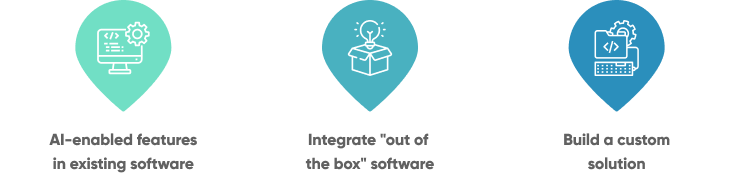
| Option | Choose it when | Confirm before approval |
|---|---|---|
| Use an existing feature | The workflow already lives in the tool and needs limited customization. | Data permissions, retention, and audit logs. |
| Integrate a platform | The capability is repeatable but needs connections to enterprise systems. | SSO/SCIM, API limits, export options, and volume cost. |
| Build a custom system | The workflow is differentiating or requires tailored controls and integrations. | Ownership of lifecycle cost, evaluation, security, and support. |
Option 1: Use governed AI features in existing software
This route is appropriate when the workflow already lives in the platform and customization is limited. Review data processing terms, tenant isolation, retention, identity provisioning, audit logs, and whether the feature can be disabled or exported.
- CRM: Salesforce Einstein can support CRM-native analytics and service workflows; validate permissions against existing customer-data access.
- Productivity suites: Microsoft 365 Copilot and Google Workspace with Gemini require identity, retention, and information-governance review before broad rollout.
Option 2: Integrate a configurable AI platform
Use a specialized platform when it offers repeatable capabilities that the organization should not maintain itself—for example, document processing, contact-center automation, or managed model access. Validate API limits, SSO/SCIM, auditability, region and retention controls, export formats, and the cost of volume growth. An IDP platform can accelerate OCR and classification, but its confidence thresholds, exception queues, and ERP integration determine the actual business result.
- General-purpose enterprise assistants: ChatGPT Enterprise may suit knowledge work when the organization validates identity, data controls, and permitted connectors.
- Managed NLP: Amazon Comprehend can add classification and entity extraction to AWS workloads without building a model from scratch.
Option 3: Build a custom or composable AI system
Build when the workflow is strategically differentiating, spans several systems, or needs tailored security and evaluation. A common architecture uses Python services for orchestration, an API layer, a relational store and object storage, asynchronous workers, and observability.
Use a vector index only when retrieval is justified. AWS services such as Bedrock, S3, RDS, SQS, Step Functions, and IAM provide managed building blocks, but they do not remove the need for evaluation, authorization, or operational ownership.
Budget for the lifecycle: discovery, integration, data preparation, evaluation, security review, monitoring, support, and change management. See AI development costs and the factors that affect them for a practical budgeting framework.
Which AI skills should be developed across departments?
AI literacy is role-specific. Business users need to understand capabilities, limits, confidential-data rules, and verification. Product owners need to define acceptance criteria and outcome metrics. Engineers need to operate secure integrations, evaluation suites, and observability. Risk and compliance teams need system inventory, supplier evidence, and incident processes.
What should technical teams be able to operate?
For custom systems, build or source capability in data engineering, cloud security, Python services, ML or LLM evaluation, and MLOps. A small platform team can standardize identity, secrets, logging, deployment, and reusable retrieval or IDP components; domain teams should still own workflow quality and decisions.
How should business teams be trained?
Train against real tasks and failure modes. Use approved tools and sanitized examples, then measure whether users can detect unsupported answers, route exceptions, and preserve customer-data boundaries. Training completion is not adoption; usage quality, exception rates, and rework are better signals.
How do you measure ROI and scale AI safely?
Measure a production AI workflow at three levels: business result, system quality, and risk. Scaling before all three are visible turns a pilot into an unbounded operating cost.
Which KPIs demonstrate business value?
Define a baseline before release and track the metric at a fixed cadence:
- Operations: cycle time, straight-through processing rate, queue backlog, cost per case, and hours of verified manual work avoided.
- Quality: extraction accuracy, grounded-answer rate, retrieval precision, false-positive or false-negative rate, and human override rate.
- Economics: gross-margin contribution, revenue conversion where causal attribution is credible, cost per successful task, model and infrastructure spend, and payback period.
- Risk: policy violations, sensitive-data exposure, incidents, unresolved exceptions, and time to rollback.
When is a use case ready to expand?
Scale a use case only after evaluation holds across representative data and teams, the integration can absorb expected volume, reviewers can manage exceptions, and the owner accepts the residual risk. Reuse patterns such as authentication, audit logging, data contracts, evaluation harnesses, and deployment pipelines—not untested prompts copied between departments.
For data-intensive use cases, production Python data pipelines are often the dependency that allows a pilot to become a reliable product.
Scale gate: Do not expand a workflow because a demo was persuasive. Expand when baseline-versus-production metrics, operating cost, audit evidence, and owner sign-off show that the result can be repeated.
How do you keep the AI program adaptable as technology changes?
Future-proofing means preserving choice and evidence, not predicting a winning model. Use modular interfaces so that models, OCR providers, retrieval stores, and orchestration components can be evaluated or replaced without rewriting the business workflow.
Maintain versioned evaluation datasets, prompts, model configurations, and deployment records. Test material changes against quality, latency, cost, security, and accessibility requirements before release. Keep contractual exit paths and export mechanisms when adopting managed AI services.
Operational principle: Preserve raw source records, human corrections, and evaluation results. They provide the evidence needed to improve a model, investigate an incident, or change vendors without losing control of the workflow.
What should happen first?
Start with one workflow where value, data, and ownership are clear. During discovery, document the baseline, data flow, risk classification, target architecture, success threshold, and rollback criteria. That scope gives the business an evidence-based decision: scale the solution, redesign the workflow, or stop before more budget is committed.
If your organization needs support defining that path, SoftKraft's AI development team can help assess readiness, design the integration and security boundaries, and build a production-grade AI workflow around measurable business outcomes.