
According to the Python Developers Survey, Django ranks as the second most popular Python framework worldwide. Its comprehensive feature set, scalability, and robust security make it a compelling choice for building powerful and reliable business applications.
Having led more than ten Django projects for enterprise clients across diverse industries, we’ve seen firsthand how this mature framework consistently delivers when paired with disciplined processes.
In this article, we share the seven practical steps we’ve refined through real-world business software development, from defining clear business requirements all the way to testing and deployment. By following this proven approach, you’ll be able to leverage Django’s strengths to create effective, scalable, and secure solutions that drive genuine business value. Let’s dive in!
Why do businesses choose the Django framework?
In the many Django projects we’ve delivered as a team, businesses repeatedly choose the framework for its unique blend of developer productivity and enterprise-grade reliability. As a high-level Python-based web development framework, Django stands out for several key reasons:
- Ease of use and simplicity: Django is known for its straightforward syntax and extensive documentation, making it accessible for both beginners and seasoned developers while still supporting complex enterprise needs.
- Mature and stable framework: With over a decade of continuous community-driven improvements, Django offers the stability and reliability that mission-critical business applications demand.
- Comprehensive feature set: Its “batteries included” philosophy provides an admin panel, ORM, templating system, authentication, and more right out of the box, dramatically accelerating development.
- High scalability: We’ve successfully scaled Django applications from early-stage MVPs to systems handling significant traffic and feature growth.
- Built-in security: Django’s secure-by-default protections against common vulnerabilities (SQL injection, XSS, CSRF, clickjacking) have saved countless hours of security work in every production deployment we’ve led.
7 easy steps to use Django for business software development
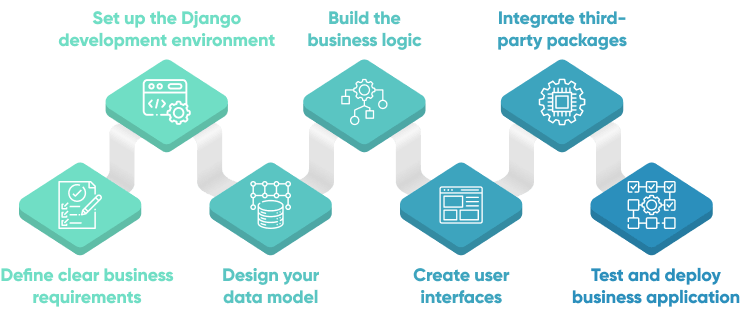
While Django offers compelling advantages, realizing its full potential in business contexts requires a structured, experience-driven methodology. Here are the seven steps we follow in every Django business application we build:
Define clear business requirements
Before writing a single line of code, investing time in thorough requirements definition is non-negotiable. In every successful project we’ve been part of, clear business requirements formed the bedrock of the entire development effort. Are you looking to optimize a specific business process, automate manual work to free up your team, or prepare the organization for future scaling?
As a Tech Lead, our approach to requirements gathering goes beyond standard documentation. We personally lead collaborative stakeholder workshops that bring together business users, product owners, and the technical team. These sessions help us prioritize features not only by business value but also by engineering constraints, technical feasibility, and long-term maintainability. This hands-on involvement lets us spot scope creep early and make informed trade-off decisions before development even begins.
To gain full clarity, we conduct a formal process of collecting, organizing, and documenting all functional and non-functional requirements. It is critical at this stage to verify that existing off-the-shelf solutions cannot adequately meet the needs. The key output is a comprehensive business requirements document containing prioritized functionality, often using the MoSCoW method:
- Must have: non-negotiable requirements
- Should have: important but not critical
- Could have: nice-to-have if time allows
- Won’t have: explicitly out of scope for this iteration
Producing this document as part of the Django software development process helps to:
- Verify that there is a legitimate need for new custom software rather than purchasing an existing solution.
- Ensure the development team has complete clarity on the requirements of the proposed business software.
- Provide a high degree of transparency right from the beginning of a project to all stakeholders.
- Prevent the final software from needing extensive rework due to missing or misunderstood criteria.
- Validate that the capabilities delivered genuinely meet the enterprise’s stated needs.
Read More: 7 Key Elements of Effective Software Requirements Specification
Set up the Django development environment
Setting up a consistent, reproducible development environment is crucial for smooth collaboration and long-term project success. In our client projects, we treat environment setup as a foundational step that prevents countless “it works on my machine” issues later.
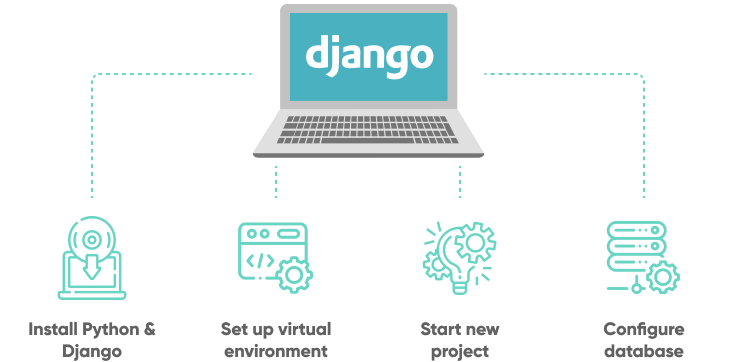
Install Python and Django
Start with the latest stable Python version, then install Django using pip.
Set up a virtual environment
Always isolate dependencies:
python -m venv .venv
source .venv/bin/activate
pip install django
Start a new project
django-admin startproject my_django_projectCreate apps as needed:
python manage.py startapp myappAdd new apps to INSTALLED_APPS in settings.py.
Configure database
We recommend configuring PostgreSQL early for production parity, even if SQLite is used in local development:
DATABASES = {
  'default': {
    'ENGINE': 'django.db.backends.postgresql',
    'NAME': 'mydatabase',
    'USER': 'mydatabaseuser',
    'PASSWORD': 'mypassword',
    'HOST': 'localhost',
     'PORT': '5432',
  }
}
Run initial migrations and start the server:
python manage.py migrate
python manage.py runserver# Use an official Python runtime as a parent image
FROM python:3.9-slim
# Set the working directory
WORKDIR /usr/src/app
# Install dependencies
COPY requirements.txt ./
RUN pip install --no-cache-dir -r requirements.txt
# Copy the project files
COPY . .
# Run the application
CMD ["python", "manage.py", "runserver", "0.0.0.0:8000"]Design your data model
Designing a solid data model early is one of the highest-leverage activities in any Django business project. The more effort invested here (building on the requirements from Step 1), the fewer painful refactors you’ll face later.
Plan the database structure
Map out entities, relationships, indexing needs, and future growth patterns before writing any code.
Define models in Django
Models in Django represent your database tables. We define them carefully:
from django.db import models

class Product(models.Model):
    name = models.CharField(max_length=100)
    price = models.DecimalField(max_digits=10, decimal_places=2)
    description = models.TextField()
    stock = models.IntegerField()
    created_at = models.DateTimeField(auto_now_add=True)
    updated_at = models.DateTimeField(auto_now=True)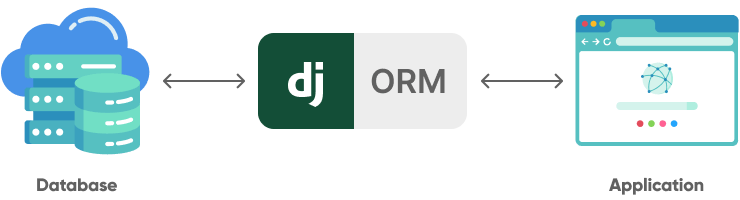
Build the business logic
This step is where your application’s unique value is implemented. In the Django projects we’ve led for business clients, we’ve learned that strong architecture and regular code reviews at this stage are what separate maintainable, scalable codebases from those that become legacy burdens.
Write custom views
Views handle requests and orchestrate business logic. We favor class-based generic views for common patterns:
from django.urls import reverse_lazy
from django.views.generic import ListView, DetailView, CreateView
from .models import Product
from .forms import ProductForm

class ProductListView(ListView):
    model = Product
    template_name = 'product_list.html'
    context_object_name = 'products'
For more complex flows, we use the base View class for full control.
Create templates
Leverage Django’s powerful templating language with inheritance for consistent, maintainable UIs.
Connect views and templates
Map everything in urls.py.
Architecture and code review practices: Throughout development, we enforce a clean app structure: each Django app focused on a single domain or responsibility (e.g., products, orders, payments). This separation of concerns keeps the codebase modular and team-friendly. When exposing data to frontends, we evaluate Django REST Framework (DRF) for standard REST APIs versus GraphQL (via Graphene or Strawberry) when clients need highly flexible querying to avoid over-fetching/under-fetching. Regular architecture-focused code reviews ensure these decisions are applied consistently.
Read More: 7 Proven Best Practices to Master Django AI Development
Create user interfaces
While Django excels at backend logic, we frequently pair it with modern frontend frameworks through APIs built with Django REST Framework.
Key strategies we use when creating UIs for business software:
- Utilize front-end frameworks like Bootstrap or Tailwind for rapid, professional styling.
- Incorporate Django’s template inheritance for consistent headers, footers, and navigation.
- Enhance interactions with JavaScript for dynamic, responsive experiences.
- Prioritize accessibility following WCAG standards.
- Improve navigation with clear sitemaps and structured routing.
Read More: UI Design Process - 7 Easy Steps to Make Great UIs Faster
Integrate third-party packages
The Django ecosystem is one of its greatest strengths. We carefully select and integrate battle-tested third-party packages to avoid reinventing the wheel.
A few packages we rely on regularly:
- Django Guardian: Fine-grained, object-level permissions with minimal boilerplate.
- Celery: Asynchronous task queues (with Redis or RabbitMQ) for email, reports, and background processing.
- Wagtail CMS: Powerful, customizable content management for content-rich applications.
- Django Filter: Elegant filtering of querysets via URL parameters.
- Sentry: Production monitoring and error tracking.
Test and deploy business application
At the final stages of development, thorough testing and careful deployment are what separate successful launches from painful production incidents.
Establish a comprehensive testing strategy
In every project we’ve delivered, a robust testing strategy has been non-negotiable. Django’s built-in test runner and TestCase classes provide an excellent foundation for unit and integration testing. For more advanced scenarios and better developer experience, we integrate pytest-django, which brings pytest’s powerful fixtures and plugins while staying fully compatible with Django. When testing complex business logic involving multiple related models, factory_boy has proven invaluable: it lets us generate realistic test data with almost zero boilerplate.
We cover:
- Unit testing of models, views, and forms.
- Integration testing of component interactions.
- Functional and end-to-end testing simulating complete user workflows.
- Performance and security testing to ensure production readiness.
Deployment
Plan for scaling (caching, load balancing, optimized queries), configure production web servers (Nginx + Gunicorn/uWSGI), choose appropriate hosting, and automate everything with CI/CD pipelines.
Read More: 10 Proven Steps to Quickly Write a QA Test Plan
Common Pitfalls We’ve Observed in Django Business Projects
From mentoring teams and reviewing dozens of production Django codebases, here are the mistakes we see most often, and how we help clients avoid them:
- N+1 query problems: Forgetting to use
select_related()andprefetch_related()on ORM queries, causing serious performance degradation under load. - Inadequate migration planning: Treating complex schema changes lightly, leading to risky deployments or data integrity issues.
- Poor app structure and separation of concerns: Dumping everything into monolithic apps instead of maintaining focused, domain-driven Django apps.
- Over-reliance on the Django admin for complex workflows: Using it for business operations that should have dedicated, custom interfaces and proper permissions.
Top challenges businesses face when using Django web framework
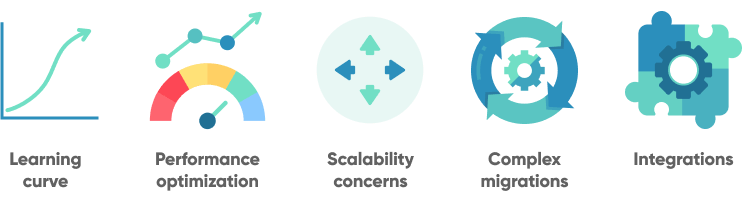
Even with Django’s strengths, teams encounter common challenges. Being aware of them and applying the lessons we’ve learned across many projects helps you mitigate risks proactively:
- Steep learning curve: Django’s conventions and full feature set take time to master, especially for teams new to the framework.
- Performance optimization: The rich feature set can introduce overhead if database queries aren’t optimized and caching strategies aren’t implemented.
- Scalability concerns: Handling high traffic requires deliberate architecture choices around caching, task queues, and database design.
- Complex migrations: As applications evolve, schema changes demand careful planning and testing.
- Integration with other systems: Connecting to legacy platforms, third-party APIs, or microservices requires thoughtful design and robust error handling.
Conclusion
By following these seven steps, refined through years of leading Django projects for real business clients, you can confidently build scalable, secure, and maintainable applications that deliver lasting value. The combination of thorough requirements definition, clean architecture decisions, strategic package usage, and rigorous testing is what separates good Django applications from truly great ones.
If you’re looking for a Python Development Company that has walked this path many times before, we’d love to partner with you. Our business software development team will work side-by-side with you to define the right strategy and deliver a production-ready Django solution tailored to your unique needs.