
7 Top Opportunities in Data Engineering Automation for 2026
Quick Answer: Data engineering automation should start where manual work creates measurable operational risk: ingestion, transformation, orchestration, data quality, compliance reporting, infrastructure provisioning and predictive maintenance. For a CTO, the goal is not "less manual work" in general. The goal is reliable AI and BI data flows built with observable pipelines, versioned infrastructure, governed access and clear ROI metrics.
According to the Fivetran Enterprise Data Infrastructure Benchmark Report 2026, data teams spend 53% of engineering time on pipeline maintenance and reactive support. The same benchmark estimates that pipeline downtime can create nearly $3 million in monthly business exposure for large enterprises. For CTOs and Data Leads, this makes automation a capacity, reliability and AI-readiness decision, not only a productivity initiative.
This article explains what data engineering automation means in production environments and where automation creates the highest return: data collection, transformation, self-healing pipelines, data quality, compliance, infrastructure scaling and predictive maintenance. The examples focus on architectures using tools such as AWS Glue, Apache Airflow, Terraform, Kubernetes, dbt, Great Expectations and cloud-native observability.
What is data engineering automation?
Data engineering automation is the use of software, metadata and operational rules to run data workflows with minimal manual intervention. It covers data extraction, transformation, loading, orchestration, validation, deployment, access control, monitoring and incident response.
In a mature data platform, automation uses metadata about source systems, schemas, owners, freshness requirements, lineage, data contracts and consumer SLAs. This metadata guides how pipelines ingest data, validate records, retry failed jobs, escalate incidents and expose trustworthy datasets to analytics, machine learning or generative AI workflows.
What is the difference between data automation and data orchestration?

Data automation and data orchestration are related, but they solve different problems in a production data platform.
Data automation executes repeatable tasks such as API ingestion, file parsing, schema validation, deduplication, partitioning and warehouse loading. For example, a team may automate ingestion from Salesforce, Stripe and product events into Amazon S3, transform the data with dbt and load curated models into Snowflake or Amazon Redshift.
Data orchestration coordinates the order, dependencies, retries, SLAs and failure handling across those automated tasks. Apache Airflow, Dagster, Prefect and AWS Step Functions help teams define DAGs, trigger jobs by schedule or event, monitor task state and route failures to the right owner.
Which business outcomes should CTOs measure?
Data engineering automation is worth prioritizing when the business can connect engineering work to reliability, margin and decision speed. The strongest ROI signals usually include:
- Lower operational toil: Fewer engineer-hours spent on broken jobs, manual re-runs, data backfills and stakeholder support.
- Higher data reliability: Better pipeline freshness, completeness, validity, uniqueness and lineage coverage.
- AI readiness: Clean, governed and well-documented datasets available for ML features, retrieval-augmented generation and analytics.
- Scalable cost control: Infrastructure and warehouse workloads provisioned through policies, autoscaling and FinOps guardrails.
- Faster time to decision: Reliable BI and operational metrics available without ad-hoc engineering intervention.
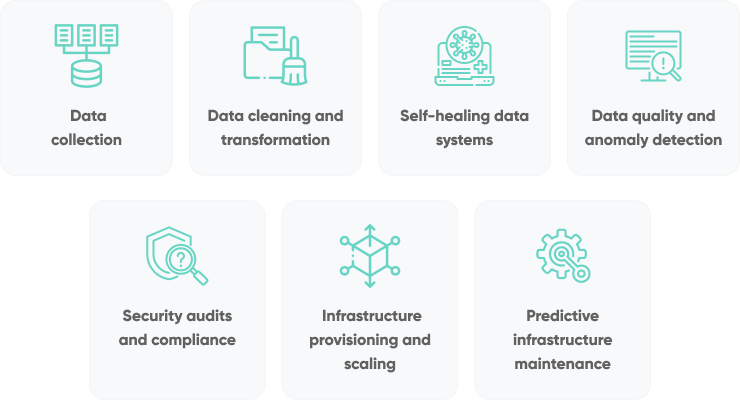
7 top opportunities for data engineering automation
The best automation roadmap starts with the workflows that fail often, block high-value teams or create compliance exposure. These seven areas usually create the strongest return for B2B SaaS, fintech, marketplace and data-heavy product teams.
Data collection
Automated data collection matters most when a business depends on many source systems: product events, CRM records, payment data, marketing platforms, support tools, transactional databases and document workflows. Manual extraction creates stale reporting, duplicated effort and weak auditability.
To automate data collection, teams typically build ingestion pipelines around APIs, event streams, CDC connectors or document processing flows. Tools such as Apache NiFi, AWS Glue, Debezium, Kafka Connect and managed ELT platforms can extract data, normalize payloads and land raw records in a controlled storage layer.
For AWS-centric architectures, a common pattern is to land raw data in Amazon S3, register metadata in AWS Glue Data Catalog, process curated tables with Spark or dbt and expose trusted datasets through Amazon Athena, Redshift or a feature store. The same pattern can support BI, machine learning and intelligent document processing when document extraction is part of the workflow.
The right success metrics are pipeline freshness, ingestion failure rate, duplicate record rate, data source coverage and the number of manual spreadsheet exports eliminated.
PRO TIP: Add ingestion controls before adding AI. Source-level contracts, schema evolution rules, dead-letter queues and idempotent reprocessing protect the platform from silent corruption. AI-assisted anomaly detection becomes more useful after these deterministic controls exist.
Read More: 8 Intelligent Document Processing Tools With The Best Accuracy
Data transformation and cleaning
Automated transformation and cleaning convert raw records into trusted business entities such as customers, accounts, transactions, invoices, sessions or subscriptions. This is where data engineering directly affects finance reporting, customer analytics, fraud models and AI features.
Key types of data cleaning tasks include:
- Deduplication and entity resolution: Merge duplicate customers, invoices or product records using deterministic keys, fuzzy matching or ML-assisted matching.
- Schema normalization: Convert inconsistent types, units, timestamps, currencies, enums and identifiers into canonical models.
- Outlier handling: Flag values outside expected distributions without deleting legitimate rare events that may matter for fraud, churn or risk analysis.
- Missing value management: Apply explicit imputation rules, null handling policies and downstream warnings instead of hiding gaps.
- Automated quality checks: Validate freshness, completeness, accepted values, uniqueness and referential integrity before data reaches analysts or AI systems.
PRO TIP: Use transformation code that can be reviewed and versioned. Tools such as dbt, Spark, SQLMesh, OpenRefine, Great Expectations and AWS Glue Data Quality help teams keep transformation logic transparent instead of burying it in one-off scripts.
- Akkio supports automated data preparation, transformation and forecasting for business teams.
- WinPure focuses on duplicate detection, standardization, missing values and business-rule validation.
- Integrate.io provides managed connectors and data pipeline capabilities for large datasets.
Creating self-healing data systems
Self-healing data systems reduce downtime by detecting failures, diagnosing likely causes and triggering predefined recovery actions. This does not mean pipelines fix every issue alone. It means routine incidents are handled through policies before engineers are pulled into manual firefighting.
Common self-healing patterns include automatic retries with backoff, checkpointed processing, dead-letter queues, schema drift isolation, compensating backfills, SLA-based alerts and runbooks connected to observability tools. ML can help classify incidents or detect unusual patterns, but recovery logic should be explicit, testable and owned.
For complex data environments, self-healing is valuable when pipeline incidents block finance closes, AI model refreshes, customer-facing analytics or operational decisions. The measurable target is lower mean time to recovery (MTTR), fewer escalations and fewer repeated incidents from the same root cause.
PRO TIP: Consider data pipeline tools with self-healing capabilities built in such as:
- Datadog for metrics, logs, traces, monitors and incident workflows across data infrastructure.
- Apache Airflow for retry policies, SLAs, sensors and DAG-level recovery actions.
- StreamSets for managed data pipelines with drift handling and operational controls.
Data quality and anomaly detection
Automated data quality protects business decisions from stale, incomplete or structurally broken data. For AI systems, quality checks also reduce hallucination risk caused by outdated retrieval sources, duplicate documents or inconsistent feature values.
Key components of data quality and anomaly detection:
- Real-time monitoring: Track freshness, volume, distribution and drift in critical tables or streams.
- Error identification: Flag incomplete records, broken joins, invalid IDs, inconsistent currencies and unexpected schema changes.
- Predictive analytics: Use historical behavior to detect unusual changes in pipeline runtime, data volume or business metrics.
- Lineage-aware triage: Identify which dashboards, ML features or downstream teams are affected by a failed dataset.
Security audits and compliance
Automated security and compliance checks are essential when pipelines process customer data, financial data, health data or confidential business documents. Manual review does not scale across modern data lakes, warehouses, SaaS integrations and ML workflows.
Data teams should automate the controls that auditors, enterprise buyers and internal risk teams repeatedly ask about:
- Access governance: Role-based access control, least privilege, approval workflows and periodic access reviews.
- Sensitive data discovery: PII, PHI, payment data, credentials and customer secrets detected before exposure.
- Encryption and retention: Automated checks for encryption at rest, encryption in transit, retention policies and backup rules.
- Audit evidence: Logs, lineage, policy results and change history exported for SOC 2, ISO 27001, GDPR or financial-sector compliance.
PRO TIP: Treat compliance automation as part of data architecture, not a separate reporting task. AWS IAM, AWS CloudTrail, AWS Config, Security Hub, Lake Formation, Terraform policies and CI/CD checks can enforce controls before data assets reach production.
- SolarWinds Papertrail provides centralized log management and searchable archives for audit trails.
- LogicGate is a cloud-based IT risk assessment system that can help automate compliance auditing tasks.
Infrastructure provisioning and scaling
Infrastructure provisioning and scaling automation helps data teams handle growing workloads without creating untracked cloud resources, inconsistent environments or surprise infrastructure costs.
Infrastructure as code (IaC) allows teams to define warehouses, buckets, IAM roles, Kubernetes clusters, networking, secrets, monitoring and job infrastructure in version-controlled code. This creates repeatable environments for development, staging and production, which is especially important for regulated B2B and fintech systems.
Scaling automation should match workload behavior. Batch ETL jobs may need scheduled capacity, streaming pipelines may need autoscaling consumers, and ML feature generation may need burst capacity. FinOps controls should cap runaway queries, unused clusters and over-provisioned jobs before they become a monthly cost issue.
PRO TIP: Several tools and platforms facilitate automated infrastructure provisioning and scaling, including:
- Infrastructure as code (IaC): Tools like Terraform, AWS CloudFormation, and Google Cloud Deployment Manager allow you to define your infrastructure in code, enabling version control, repeatability, and consistency in provisioning environments.
- Configuration management: Tools such as Ansible, Puppet, and Chef automate the deployment, configuration, and management of applications and infrastructure, ensuring that systems are configured to a desired state.
- Auto-scaling services: AWS Auto Scaling and Azure Autoscale automatically adjust the number of compute resources based on demand, ensuring applications maintain performance and availability during varying load conditions.
- Container orchestration: Kubernetes and Docker Swarm manage containerized applications, providing automated deployment, scaling, and operations of application containers across clusters of hosts.
Predictive data infrastructure maintenance
Predictive maintenance uses historical telemetry, runtime metrics and anomaly detection to identify data infrastructure issues before they become outages. This approach is useful for warehouses, streaming clusters, workflow schedulers, storage layers and customer-facing analytics features.
Good predictive maintenance combines logs, metrics, traces, lineage and cost data. For example, a platform can detect that Airflow task duration is drifting upward, warehouse queue time is increasing, Kafka consumer lag is growing or a dashboard dataset is likely to breach its freshness SLA. Automated alerts can then trigger scaling, reprocessing, ownership escalation or a controlled incident workflow.
PRO TIP: Standardize on dedicated Data Observability and APM platforms rather than generic monitoring tools.
- Use Monte Carlo or Datadog Data Jobs Monitoring to track pipeline runtimes, warehouse queue times, and downstream lineage impacts.
- Leverage Splunk or Elastic Stack (ELK) for deep log correlation across your Kubernetes clusters and serverless Spark engines to catch failure patterns before they trigger a hard stop.
- Deploy Azure Monitor (if operating in the Azure cloud ecosystem) to automatically scale node pools or trigger alerts on performance bottlenecks.
Read More: Generative AI vs Predictive AI: 7 Key Distinctions
How should CTOs prioritize a data engineering automation roadmap?
CTOs should prioritize automation by operational pain, business exposure and implementation complexity. A practical first roadmap often looks like this:
- Weeks 1-2: Baseline the platform. Measure pipeline failure rate, MTTR, data freshness, manual re-run volume, critical datasets and cloud cost hotspots.
- Weeks 3-6: Stabilize ingestion and quality. Add schema contracts, idempotent ingestion, quality checks and alerting for revenue, customer and product datasets.
- Weeks 7-10: Automate orchestration and recovery. Standardize DAG ownership, retries, SLAs, runbooks, backfills and incident routes.
- Weeks 11-12: Add governance and IaC. Move infrastructure and access controls into versioned policies, then connect evidence to compliance reporting.
This roadmap is especially relevant before AI initiatives. LLM apps, predictive models and executive dashboards all depend on reliable source data, documented lineage and controlled access.
Data engineering automation with SoftKraft
SoftKraft helps product and data teams design automation roadmaps, modernize pipelines and build production-grade data platforms. Our data engineering services cover ingestion, cloud data architecture, Python data pipelines, AWS integrations, observability, infrastructure as code and governance for analytics or AI workloads.
If your team is preparing for AI, reporting modernization or pipeline cost reduction, start with a focused assessment: which datasets generate revenue, which pipelines fail most often, which manual tasks consume engineering capacity and which controls are required by customers or regulators. That assessment turns automation from a generic backlog item into a measurable software ROI plan.
For deeper technical context, read 7 Expert Tips to Build High-Performance Python Data Pipelines and Outsource Data Engineering - 7 Steps from Planning to Execution.
Conclusion
Data engineering automation creates the strongest value when it targets recurring operational risk: broken ingestion, inconsistent transformations, weak data quality, manual compliance evidence, untracked infrastructure and reactive maintenance. For CTOs, the business case is clear: fewer pipeline incidents, faster access to trusted data, better AI readiness and lower engineering capacity spent on repetitive support work.