
Outsource Data Engineering: 7 Steps from Planning to Execution
Quick Answer: Outsource data engineering when a defined data product, migration, or pipeline requires skills your team cannot staff quickly, but retain internal ownership of data architecture and business rules. A capable partner should deliver a scoped Python/AWS data stack, measurable reliability and cost targets, security controls, and documented handover—not merely additional developers.
External data engineering teams can help close a capability or delivery gap, but outsourcing does not transfer accountability for data quality, access decisions, or regulatory obligations. This guide explains how CTOs, founders, and COOs can scope an engagement, evaluate technical delivery, and retain operational control.
- When should a company outsource data engineering?
- Build in-house vs outsource: a decision framework
- How do you outsource data engineering without losing control?
- Define which data engineering work to outsource
- Prepare a data engineering statement of work
- Assess a data engineering partner’s technical maturity
- Establish communication and escalation protocols
- Establish data governance, access, and compliance controls
- Deliver data pipelines in controlled iterations
- Plan knowledge transfer and a vendor exit
- What does a successful outsourced data engineering engagement look like?
When should a company outsource data engineering?
Outsource when the required outcome is bounded and measurable: modernizing a warehouse, integrating new sources, building an event stream, or preparing governed datasets for analytics and AI. Keep product ownership, domain definitions, and approval rights in-house; use a partner for scarce execution skills and temporary capacity.
- Specialized delivery: A partner can supply skills in Python, SQL, Apache Airflow, dbt, Spark, AWS Glue, Amazon Redshift, Snowflake, or Databricks without requiring a permanent hire for every discipline.
- Elastic capacity: An external team can scale around a migration or integration milestone, then transition to a smaller maintenance model.
- Lower delivery risk: Experienced engineers can establish infrastructure as code, CI/CD, data-quality tests, lineage, and observability from the first release instead of treating them as later remediation work.
- A clearer economic decision: Compare vendor cost with fully loaded internal cost, cloud spend, expected reduction in manual work, and the value of faster reporting or model deployment. This produces a defensible ROI baseline rather than a rate-card comparison.
Build in-house vs outsource: a decision framework
Choose the delivery model based on the duration of the capability need, the strategic value of the domain knowledge, and the level of execution risk—not on hourly rate alone. Many organisations use a hybrid model: an internal data owner and platform architect set priorities and controls, while an external team delivers a bounded migration or specialist capability.
| Decision factor | Build in-house | Outsource or extend the team |
|---|---|---|
| Core domain knowledge | The pipeline encodes proprietary business logic that must evolve daily with product decisions. | The work is implementation-heavy and business rules can be captured in data contracts and acceptance criteria. |
| Capability duration | The organisation needs a permanent data platform function and can recruit, mentor, and retain the required roles. | The need is time-bounded, such as a migration, new integration, or reliability remediation programme. |
| Technical risk | The internal team already operates the selected cloud and data stack. | The project requires skills in a platform or pattern the internal team does not yet operate, such as Airflow, Spark, streaming, or AWS lakehouse services. |
| Governance ownership | Internal teams can provide data owners, access approvers, and security oversight. | The client retains those accountabilities while the vendor works within documented controls. |
| Success measure | The team can improve and operate the platform against agreed product and reliability targets. | The contract ties delivery to accepted datasets, operational documentation, service levels, and knowledge transfer. |
How do you outsource data engineering without losing control?
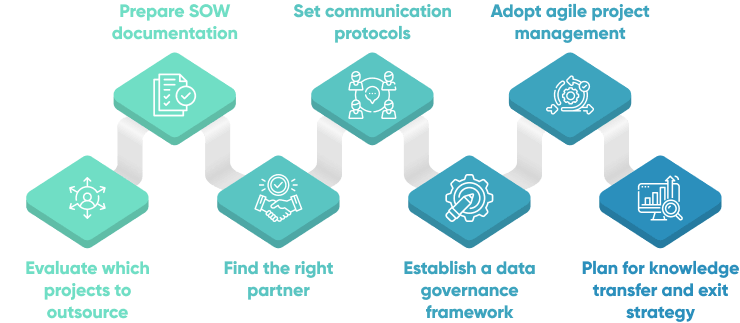
The seven steps below turn an outsourcing decision into an auditable delivery model: clear outcomes, architecture constraints, governance, acceptance criteria, and an exit path.
Define which data engineering work to outsource
Outsource a defined capability gap, not an undefined responsibility for “all data.” Good candidates include a cloud data-platform migration, an ingestion layer for new SaaS or ERP sources, a batch or streaming pipeline, and a data-quality remediation programme. Retain decisions about data definitions, customer-facing metrics, and risk acceptance internally.
Assess complexity through interfaces and operational requirements: source-system volatility, data volume and latency, PII classification, recovery objectives, and the number of downstream consumers. For example, a Python/Airflow batch pipeline may be suitable for a focused team extension; a domain-critical pricing model needs strong internal product ownership even when implementation is external.
Outsourcing data engineering might be a good fit for:
- Projects that exceed your team’s current capacity or expertise in cloud data platforms, orchestration, or distributed processing
- Time-bounded migrations and integrations that do not justify permanent recruitment
- Work with explicit service-level objectives for freshness, completeness, latency, availability, and cloud cost
Decision check: Define a baseline before selecting a vendor: current manual hours, pipeline failures, reporting latency, cloud spend, and the business decision affected by each dataset. Reassess those measures after release to evaluate ROI.
Read More: 6 Steps to Accurately Estimate Software Development Costs
Prepare a data engineering statement of work
The scope of work (SOW) should define both the data product and the operating model. A backlog alone is insufficient: the vendor needs explicit source contracts, target schemas, ownership boundaries, acceptance tests, and non-functional requirements.
A useful SOW connects deliverables to business decisions—for example, “finance receives a reconciled daily revenue dataset by 09:00 UTC”—and specifies how the team will prove that outcome. Contractual wording should be reviewed by appropriate legal and procurement stakeholders.
Key elements of a SOW:
- Business objective and data consumers: Name the decisions, teams, and systems that will use each dataset.
- Deliverables and acceptance criteria: Define source-to-target mappings, data contracts, transformation rules, test coverage, documentation, and deployment artefacts.
- Architecture constraints: State the approved cloud environment, Python or SQL standards, orchestration tool, storage format, networking, IAM model, and integration boundaries.
- Service levels: Set measurable targets for freshness, latency, pipeline recovery, data completeness, cost ceilings, and incident response.
- Security and compliance: Record data classification, encryption, retention, audit logging, access reviews, subprocessors, and applicable obligations such as GDPR, HIPAA, or PCI DSS.
- Dependencies and risks: Identify source-system owners, access prerequisites, data-quality assumptions, change-control rules, and post-launch support.

Assess a data engineering partner’s technical maturity
Evaluate evidence, not technology logos. Ask a prospective partner to explain how it has designed, tested, deployed, monitored, and handed over a comparable system. The discussion should cover failure modes and trade-offs, not only a preferred toolset.
- Relevant architecture experience: Look for production experience with your likely stack, such as Python, Airflow or Prefect, dbt, AWS Glue, Amazon S3, Redshift, Kafka, Snowflake, or Databricks.
- Delivery controls: Verify pull-request review, automated testing, infrastructure as code, CI/CD, secrets management, and environment separation.
- Data reliability practice: Ask how the team implements schema checks, lineage, data-quality assertions, alerting, backfills, and incident runbooks.
- Security posture: Confirm least-privilege IAM, encryption in transit and at rest, audit trails, access-review cadence, and a clear data-processing agreement.
- Commercial transparency: Review team composition, rate assumptions, cloud-cost responsibility, change-request process, and the ownership of code, documentation, and infrastructure.
Due-diligence prompt: Ask the partner to walk through a production pipeline failure: how it was detected, contained, corrected, communicated, and prevented from recurring. The answer reveals more than a generic delivery presentation.
Read More: How to Find Software Development Partners - Steps-by-Step Guide
Establish communication and escalation protocols
Communication must expose delivery risk early. Set a predictable operating cadence with named decision-makers, a shared backlog, architecture decision records (ADRs), and visible data-quality and delivery metrics.
Here are some key elements to include in your communication protocols:
- Assign accountable owners on both sides. The internal product or data owner prioritizes business outcomes; the vendor’s delivery lead owns execution and escalation.
- Use a fixed reporting format. Weekly updates should state completed acceptance criteria, planned work, risks, dependency changes, pipeline health, and cloud-cost variance.
- Define a decision and escalation path. Document response expectations for security incidents, broken source contracts, failed data-quality checks, and production releases.
Establish data governance, access, and compliance controls
Data governance is a delivery requirement, not a post-launch audit. Establish ownership, classification, access, retention, and evidence requirements before the vendor receives production data. The controls should map to the organisation’s B2B compliance obligations and security policies.
To establish an effective data governance framework with your vendor, focus on these key areas:
- Assign data roles. Name data owners, stewards, custodians, and approvers across the client and vendor teams.
- Make quality observable. Define completeness, validity, uniqueness, timeliness, and reconciliation checks; surface failures in the same incident process as application failures.
- Enforce access controls. Use role-based access control, least-privilege IAM, short-lived credentials where supported, encryption, secrets management, and auditable access logs.
- Map compliance requirements. Document the lawful basis, data-processing terms, retention rules, regional restrictions, and evidence needed for frameworks such as GDPR, HIPAA, or PCI DSS where applicable.
Deliver data pipelines in controlled iterations
Use short delivery increments that produce a deployable vertical slice: one source, one validated transformation, one governed target, and one consumer-facing output. Each increment should include automated tests, monitoring, documentation, and a production release path—not just a notebook or a manually run script.
For a Python/AWS implementation, this might mean versioned ingestion into Amazon S3, transformations orchestrated by Airflow, data-quality checks before a warehouse load, and alerting tied to an on-call runbook. Review architecture decisions, cost signals, and data-product acceptance criteria in every sprint.
Agree the operational targets before implementation. Useful examples include a freshness SLO for a finance dataset, a maximum recovery time for a failed pipeline, a completeness threshold for mandatory fields, a defined response time for a severity-one data incident, and a monthly cloud-cost budget. The exact values must reflect business impact and source-system constraints; they should not be copied from another project.
Delivery check: Require a demonstrable deployment pipeline and rollback procedure before approving the first production dataset. “Agile” without release and operational controls does not reduce production risk.
Read More: How to Create a High-Performing Cross Functional Agile Team?
Plan knowledge transfer and a vendor exit
A vendor engagement is complete only when the client can operate, change, or transition the platform without relying on undocumented knowledge. Put handover requirements into the SOW and make them acceptance criteria throughout delivery, rather than leaving them for the final week.
- Transfer the complete operating system. Include architecture diagrams, data contracts, repository access, infrastructure-as-code state, CI/CD configuration, runbooks, incident history, and cost dashboards.
- Run structured shadowing and reverse-shadowing. The vendor demonstrates operations; the internal team then performs deployments, recovery, and backfills under supervision.
- Define an exit sequence. Specify access revocation, credential rotation, transfer of repositories and artefacts, data deletion or return, and a period of transition support.
- Test continuity. Validate that an internal engineer can resolve a representative pipeline failure using the documentation and permissions provided.
What does a successful outsourced data engineering engagement look like?
Successful outsourcing produces a reliable, governable data platform and a client team that can own it. The measurable outcome is not vendor activity; it is trusted data delivered within agreed reliability, security, and cost constraints, with a credible path to internal operation.
Before starting an engagement, assess whether your organisation is ready to operationalise the resulting datasets for analytics or AI. Our guides on Python data pipelines, data engineering automation, and data maturity provide the next technical context. For an architecture and delivery assessment, see our data engineering services or contact the SoftKraft team.