
Enterprise MVP Development in 2026: 12 Do's and Don'ts for AI-First Architecture
Quick Answer: An enterprise MVP in 2026 should validate one measurable workflow—not a broad product vision—while proving that its data, security controls, integrations, and AI operating model can reach production. Define a business KPI, test the riskiest AWS/Python and AI assumptions in a PoC, enforce identity and data boundaries from day one, and release to a controlled user cohort before scaling.
Enterprise MVP delivery is a controlled experiment within a real operating environment. CTOs, founders, and COOs must validate user value while satisfying SSO, role-based access control, auditability, procurement, legacy-system constraints, and sector-specific obligations such as GDPR, SOC 2, ISO 27001, DORA, or HIPAA where applicable.
AI raises the architectural bar. A prototype that calls an LLM API is not evidence of a production-ready workflow. The MVP must establish data classification, retrieval permissions, evaluation criteria, failure handling, latency budgets, and a defensible unit-cost model. This guide focuses on the decisions that make those requirements testable before an enterprise commits to a wider rollout.
- Why do enterprises use MVPs instead of full-scale delivery plans?
- Enterprise MVP vs. startup MVP
- Six practices for a production-ready enterprise MVP
- Narrow down your feature set
- Plan the architecture and operating constraints before building
- Build a delivery partnership with clear decision rights
- Use a proof of concept to retire the highest-risk assumption
- Protect quality with automated, risk-based controls
- Maintain a roadmap tied to evidence and operating capacity
- Six enterprise MVP delivery failures to avoid
- Enterprise-readiness checklist before scaling an AI MVP
Why do enterprises use MVPs instead of full-scale delivery plans?
Enterprise software development has traditionally favoured long planning cycles: detailed requirements, extensive stakeholder sign-off, multi-year roadmaps. An MVP replaces a large, assumption-heavy release with an instrumented release that answers a specific decision: whether a defined user group can complete a high-value workflow more accurately, quickly, safely, or cheaply.
The MVP approach breaks that pattern: ship a focused, working product, learn from real users, and use the evidence to decide the next investment. The enterprise question is not whether to adopt MVP development, but how to retain governance and integration discipline while reducing the time between an assumption and a decision.
Enterprise MVP vs. startup MVP
An enterprise MVP has a narrower product scope than a full release, but it cannot ignore production constraints. It often needs to authenticate through an identity provider, exchange data with ERP or CRM systems, produce audit trails, and meet security review criteria before the first pilot. A startup can sometimes defer those decisions; an enterprise usually cannot.
Let's look at the key differences:
| MVP Development for Enterprise | MVP Development for Startups | |
|---|---|---|
| Definition | Scaled-down versions of a customer-facing product or an internal solution aimed at a specific business unit. | Basic version of a product with just enough features to be usable by early customers. |
| Scope | A focused workflow, including only the integrations, controls, and audit evidence required for a credible pilot. | A narrow product slice centered on a direct user need. |
| Budget | Funds the product slice plus essential integration, security, and acceptance testing. | Prioritises product discovery and the smallest usable release. |
| Timeline | Short delivery increments, with security, integration, and approval work run in parallel. | Rapid development cycles focused primarily on market learning. |
| Risk Tolerance | Enterprises are generally risk-averse, often showing reluctance towards untested technologies and concepts. | Startups are more inclined to embrace risk, experimenting, and dealing with uncertainties as part of their growth process. |
| User Base | Usually crafted for a specific, defined internal or external user group. | Typically intended for a wider, less-known audience of early adopters. |
| Feedback Process | The feedback mechanism is comprehensive and methodical, involving numerous internal and external stakeholders. | Startups prioritize direct user feedback, which is collected through dynamic means such as product testing, surveys, and early adopter engagement. |
| Regulatory Compliance | Enterprise MVPs must conform to specific industry regulations and data protection protocols, introducing additional layers of complexity and extending the development timeline. | While startups may initially enjoy greater leeway regarding regulations, they must progressively confront compliance demands as their user base and data holdings expand. |
Six practices for a production-ready enterprise MVP

The six practices below keep the MVP small without making it disposable. Each gives product and engineering leaders evidence for a scale, stop, or redesign decision.
Narrow down your feature set
Start with one end-to-end job that has a named user, a system boundary, and a measurable outcome. For example, an accounts-payable MVP can ingest a supplier invoice, extract fields through an OCR or intelligent document processing (IDP) service, send exceptions to a reviewer, and export an approved record to the ERP. It does not need every document type, every approval path, or a full supplier portal.
Prioritise the workflow according to its expected business result: cycle-time reduction, error-rate reduction, revenue protection, cost avoidance, or compliance evidence. Then define the baseline, target, owner, and measurement method before the team estimates features. To select the right feature set, consider:
- The system being replaced. Identify the essential capabilities, dependencies, and operational workarounds that the pilot must preserve.
- User incentives and friction. Interview the people who perform the work to identify adoption triggers, failure points, and unacceptable disruptions.
- Workflow constraints. Release a complete, controlled slice of a workflow rather than an incomplete replacement for an entire system.
PRO TIP: Use more than one feedback method:
- User interviews: Reveal the context behind a workflow and the consequences of failure.
- Internal focus groups: Expose differences between teams, roles, and hand-offs.
- Surveys: Quantify a pattern discovered in interviews; do not use them as a substitute for observation.
Read More: Custom Enterprise Software Development - 7 Tips for Success
Plan the architecture and operating constraints before building
Planning is where an enterprise MVP avoids avoidable rework. Document the functional slice alongside non-functional requirements: target availability, recovery objectives, data residency, access model, audit retention, peak load, integration ownership, and acceptable AI latency. These decisions let an architecture review assess a concrete design instead of a slide deck.
For an AWS and Python-based MVP, agree on the account boundary, IAM roles, encryption with AWS KMS, network access, secrets management, CI/CD controls, observability, and service ownership for Amazon RDS, S3, SQS, or Bedrock. Use the AWS Well-Architected Framework Security Pillar as a current control baseline; its latest document revision is November 2024.
Plan the delivery around these artefacts:
- Clarify the MVP's purpose: Define the primary objectives and expected outcomes of the MVP clearly. This should articulate what success looks like and how it aligns with broader business goals.
- Map stakeholder influence: Catalog all stakeholders, detailing their roles, expectations, and the extent of their decision-making authority. Understanding the influence each stakeholder has ensures their needs are adequately addressed and prioritized.
- Assess team impact: Identify all internal and external teams involved in or affected by the MVP development project and final product. Outline their contributions, how the project impacts them, and strategies for maintaining operational continuity.
- Strategize risk mitigation: Record technical, data, vendor, security, and adoption risks with an owner, trigger, mitigation, and decision deadline.
- Define acceptance evidence: Specify the test dataset, UAT scenario, security checks, telemetry, and KPI threshold required to move from pilot to the next investment decision.
PRO TIP: Put the in-scope workflow, exclusions, interfaces, non-functional requirements, acceptance evidence, and decision owners in the statement of work. This prevents a pilot from becoming an undeclared platform programme.
Read More: Software Development Scope of Work [Template, Tips & Tools]
Build a delivery partnership with clear decision rights

An enterprise MVP needs a decision model, not just goodwill. Assign a product owner accountable for the KPI, a technical owner accountable for architecture, and named representatives for security, data, and operations. Agree who can accept scope trade-offs, who approves data access, and how an unresolved decision escalates.
This delivery model enables the team to:
- Make trade-offs explicit, so technical teams and business stakeholders work from the same constraints and evidence.
- Streamline the approval processes by using pre-agreed decision rights and review windows, rather than relying on ad hoc consensus.
- Change scope safely when evidence invalidates an assumption, without losing control of dependencies or release commitments.
- Protect the operating model by involving the teams that will support the MVP after launch.
PRO TIP: Name a champion in each affected function—business, security, data, operations, and support—and give each one a defined review responsibility.
Use a proof of concept to retire the highest-risk assumption
When navigating the MVP development process within your enterprise, starting with a proof of concept (PoC) reduces risk and surfaces integration challenges early. In the current environment, that principle applies to AI capabilities just as much as to any other technical component.
If the MVP incorporates AI, the PoC should test more than whether a model produces a plausible answer. It should test whether the selected model, retrieval layer, and workflow meet a defined quality, cost, latency, and security threshold on representative data. Keep the PoC separate from the production path until it earns that promotion.
- Surface model limitations early: Test model outputs against a curated evaluation set. This reveals whether retrieval-augmented generation (RAG), a deterministic rules layer, fine-tuning, human review, or a different model is required.
- Validate data controls: Confirm that document classification, PII handling, tenant isolation, prompt-injection controls, and source-level permissions behave as designed.
- Refine the MVP scope: Use the PoC results to decide which AI tasks can be automated, which need human approval, and which should be removed from the first release.
Protect quality with automated, risk-based controls
Speed without controls produces a demo, not an enterprise MVP. Establish a minimum release gate that covers automated tests, integration tests, security scanning, audit logging, monitoring, and a rollback path. Increase the depth of testing where the workflow creates financial, regulatory, safety, or customer-impacting risk.
To maintain quality throughout:
- Protect the critical user journey: Test the workflow users must complete to obtain value, including accessibility, error messages, and manual recovery.
- Implement a phased testing approach: Begin with unit tests and progress to integration and user acceptance testing, ensuring each component works seamlessly both independently and within the larger system.
- Conduct regular security reviews: Apply threat modelling and dependency, secret, infrastructure-as-code, and dynamic security checks in the delivery pipeline. For AI workflows, test unsafe tool calls, data exfiltration paths, and prompt injection.
- Assign QA capacity: Give test design, automation, exploratory testing, and defect triage named owners before the pilot starts.
Maintain a roadmap tied to evidence and operating capacity
An enterprise roadmap should be flexible about features and firm about decision points. Each release should state the hypothesis, user cohort, KPI, technical constraint, and decision it will unlock. This makes a roadmap change legible to finance, security, and operational stakeholders instead of looking like uncontrolled scope drift.
To keep your roadmap adaptable:
- Challenge assumptions: Revisit the hypothesis when KPI, user, or operational evidence contradicts it.
- Share decision-grade evidence: Give product, security, operations, finance, and support teams the same KPI and user-feedback summary before a scope decision.
- Stay agile within guardrails: Iterate in small increments while preserving change-control, release evidence, and operational readiness requirements.
PRO TIP: Consider working with an outside software development company or agile outsourcing company who can provide expertise to guide agile development best practices and provide agility that may otherwise be difficult to achieve internally in an enterprise environment.
Six enterprise MVP delivery failures to avoid
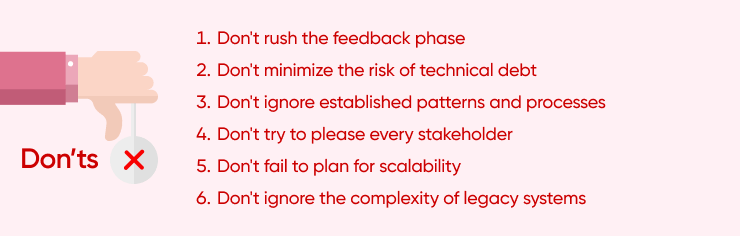
The following anti-patterns make a pilot difficult to govern, measure, or scale. Several predate AI; AI amplifies their impact by adding data, model, and cost dependencies.
Rush the feedback phase
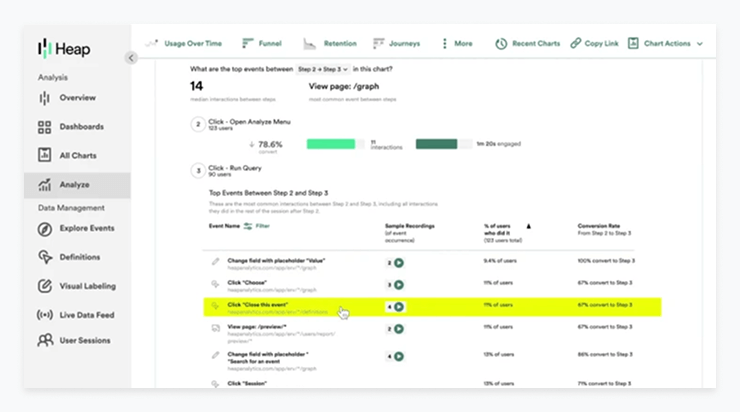
Feedback is useful only when it tests the MVP hypothesis. Define the pilot cohort, the workflow they will execute, the baseline metric, and the observation period before launch. Combine user interviews with product analytics, operational error data, and support signals; executive opinion alone cannot validate adoption.
Use the following feedback design:
- Broaden the feedback pool: Include frontline users, managers, support, IT, and representative external users where appropriate.
- Use an internal launch deliberately: Validate operational readiness and support processes before exposing customer-facing workflows.
- Recruit representative testers: Select users who execute the target workflow, not only advocates or senior stakeholders.
PRO TIP: Use product analytics to connect observed behaviour with the KPI, but pair it with interviews or session review to explain why users abandon or bypass a workflow.
Try to satisfy every stakeholder request
Attempting to satisfy every request turns a validation release into a delayed platform project. Record requests, but rank them by their contribution to the MVP KPI, risk reduction, and dependency removal. A feature that has no effect on the pilot decision belongs in a later release.
- Limit the scope: Include a feature only when it changes the MVP decision, reduces a material risk, or removes a delivery dependency.
- Establish decision ownership: Name the person who accepts each scope, architecture, and data-access trade-off.
- Involve key stakeholders early: Ask IT, security, operations, and commercial teams for constraints while the scope is still inexpensive to change.
Ignore the scale, reliability, and cost envelope
An MVP does not require the capacity of the final platform, but it does require an explicit operating envelope: expected concurrency, document volume, API limits, data retention, service-level objective, recovery target, and cost per completed workflow. Without it, a successful pilot can become an unplanned production incident.
For AI-powered products, calculate model inference, embedding, retrieval, and human-review costs under realistic volumes. Measure p50 and p95 latency, queue backlogs, rate limits, and fallback behaviour. Use asynchronous processing where a workflow permits it—for example, Python workers consuming Amazon SQS messages—and expose status clearly rather than making users wait on a synchronous model call.
Learn More: Data & Cloud Experts
Underestimate legacy-system and data-integration constraints
Legacy integration is usually the critical path, not the UI. Confirm API availability, data ownership, batch windows, master-data quality, authentication method, and change-control process before promising a pilot date. If an ERP exposes only overnight files, the MVP cannot truthfully claim real-time processing.
- Foster collaboration between IT teams, developers, and business stakeholders to ensure a holistic understanding of legacy system challenges and their impact on the MVP app development.
- Develop a clear integration strategy that identifies system-of-record boundaries, API or file interfaces, schema ownership, retry and idempotency behaviour, and reconciliation.
- Develop a data migration and validation strategy when the MVP copies or transforms legacy data. Define mapping, data-quality thresholds, lineage, retention, and rollback before the first transfer.
PRO TIP: Check whether the MVP supports an existing legacy software modernization programme. If it does, reuse the approved target architecture and migration guardrails rather than creating a parallel integration path.
Treat AI as a feature to bolt on
When AI is part of the value proposition, it is an architectural dependency. Deferring the decision creates rework: data schemas that cannot support retrieval, services that lack boundaries for tool use, UI flows that assume synchronous responses, and security controls that cannot identify what data a model can access.
If AI capabilities belong in your product, they need to be in the architecture from the first sprint:
- Choose an orchestration model early. Direct model calls, a LangGraph-style stateful workflow, and asynchronous Python services have different state, observability, and failure requirements. Avoid autonomous agents for a task that a deterministic workflow can execute safely.
- Plan the AI data layer for authorised access. Retrieval chunking, embeddings, metadata filters, document lineage, and access-control propagation are infrastructure decisions. A vector index must not bypass a user's existing permissions.
- Make model risk observable. Log model and prompt versions, retrieval sources, tool calls, evaluation results, human overrides, latency, and cost. Review this evidence against NIST AI 600-1, the Generative AI Profile, published in July 2024 and updated by NIST in April 2026.
The MVP should include only AI tasks whose evaluation evidence, escalation path, and data controls meet the agreed risk threshold. Other tasks belong in a later release or remain deterministic.
Treat governance as a late-stage approval exercise
Security, privacy, architecture, and procurement reviews are not obstacles to work around; they are design inputs. The delivery failure is discovering those inputs after the team has chosen vendors, moved data, or completed an irreversible integration.
On AI-assisted projects, delivery can outpace approval capacity. Without scheduled reviews and reusable evidence, the team can be blocked after implementation rather than guided before it.
Address this upfront rather than after the first blocked sprint:
- Map approval gates before kick-off. Identify security, privacy, architecture, change-management, legal, and procurement reviews. Put evidence deadlines and accountable owners on the delivery plan.
- Start third-party and AI vendor due diligence early. Review data-processing terms, retention, sub-processors, regional availability, identity integration, and exit options before production data enters a tool.
- Separate pilot and external-release controls. An internal pilot may use a smaller cohort, masked data, lower permissions, and manual approval. It still needs an explicit risk decision; it does not remove the need for governance.
Enterprise-readiness checklist before scaling an AI MVP
Before investing in scale, an enterprise team should be able to show that a defined cohort completes the target workflow, the KPI improves against a baseline, data access is controlled, integrations reconcile correctly, and the operating cost is acceptable. For AI features, the evidence should also cover evaluation quality, human escalation, model failure handling, and traceability.
Use this enterprise-readiness checklist before moving beyond a pilot:
- Business: a named owner, baseline, target KPI, and decision rule for scale, stop, or redesign.
- Architecture: documented system boundaries, integration contracts, SLOs, recovery expectations, and capacity/cost envelope.
- Data and AI: classified data, permission-aware retrieval, representative evaluation set, human-review path, and model observability.
- Security and compliance: SSO/RBAC, encryption, audit logs, threat model, vendor due diligence, and applicable compliance mapping.
- Operations: deployment pipeline, monitoring, alert ownership, incident runbook, rollback, and support process.
For related design decisions, read our guides to building an MVP, web application architecture, building AI products, and an AWS security incident response plan.
If you are scoping an enterprise MVP, talk to our enterprise software team about the workflow, constraints, and evidence required for a production decision.